
CATEGORY HERE
Why Your Referrals Are Leaving - and What Brings Them Back

A vice president of operations is assembling routine figures for a payer meeting when one column begins to look peculiar. A surprising number of cardiology referrals from the system’s own primary care physicians are going to the hospital across town. A second look confirms the pattern. Then a third removes any hope that it is a reporting error.
The referrals have been leaving for years. No one noticed because no one had thought to ask precisely where they were going.
Leadership’s first response is understandable, if not especially useful: Why are our own doctors sending revenue to the competition? The language soon turns to loyalty, leakage, and recapture. Reports are commissioned. Dashboards acquire red arrows. Someone may suggest a memo.
Yet physicians rarely direct patients elsewhere as an act of corporate dissent. They tend to follow the pathways that have proved dependable—the specialist who returns a call, the office that finds room for a patient, the scheduler who knows what to do without transferring anyone three times.
What appears on the balance sheet as lost revenue often begins elsewhere, in something quieter and more consequential: a relationship that was never built.
At Sopra Health, we believe that treating referral leakage principally as a compliance problem, rather than evidence of a relationship gap, is one of the greatest barriers to sustainable network growth.
The Reputation Inside Every Referral
A primary care physician does more than transmit an order when making a referral. The physician lends the specialist a portion of an established professional reputation.
This is borrowed trust. A PCP who has cared for someone over time is, in effect, assuring that patient that the next physician will be competent, responsive, and worthy of confidence. The referral may require only a few selections in an electronic record, but the social transaction is considerably larger.
If the specialist is dismissive, the telephone goes unanswered, or the first available appointment is two months away, the patient may not regard these as isolated failures of the specialty practice. The patient remembers who made the recommendation.
Clinicians therefore develop referral habits from experience. They rely on colleagues who call back, offices that make scheduling manageable, and specialists whose care does not create an avoidable trail of confusion. Personal familiarity helps. So does simple competence at the small courtesies on which complicated systems depend.
In the absence of such knowledge, the choice can become surprisingly accidental: the first recognizable name in the system, the practice used last time, or the option that appears most readily on the screen. Healthcare may be scientifically complex, but some of its most important traffic patterns are still governed by memory, convenience, and whether anyone answers the telephone.
Health systems invest heavily in reaching prospective patients and negotiating with insurers. Far fewer devote comparable attention to helping their own primary care physicians understand, access, and trust their specialty services.
Meanwhile, the hospital across town may be doing nothing particularly ingenious. Its specialists return calls. Its liaisons visit practices. Its scheduling staff know how to receive a referral without making the referring office solve an administrative puzzle. The competitor is not necessarily stealing the business. It may simply be present where the home network has been absent.
Sopra Health senior consultants have found that internal referral velocity increases by 40 percent when specialty groups actively bridge the communication gap with primary care partners. The figure points to a practical lesson: referral patterns can change when communication becomes reliable and relationships become visible.
The useful question, then, is not merely how to stop referrals from leaving. It is what would make the system’s own physicians confident in sending patients to its specialists.
Rebuilding the Connection
Internal physicians are a distinct audience. They have their own needs, experiences, and reasons for choosing one referral path over another. Reaching them requires a strategy, an accountable owner, and an appropriate budget.
Three areas deserve particular attention.
Tell the Story Physicians Need to Hear
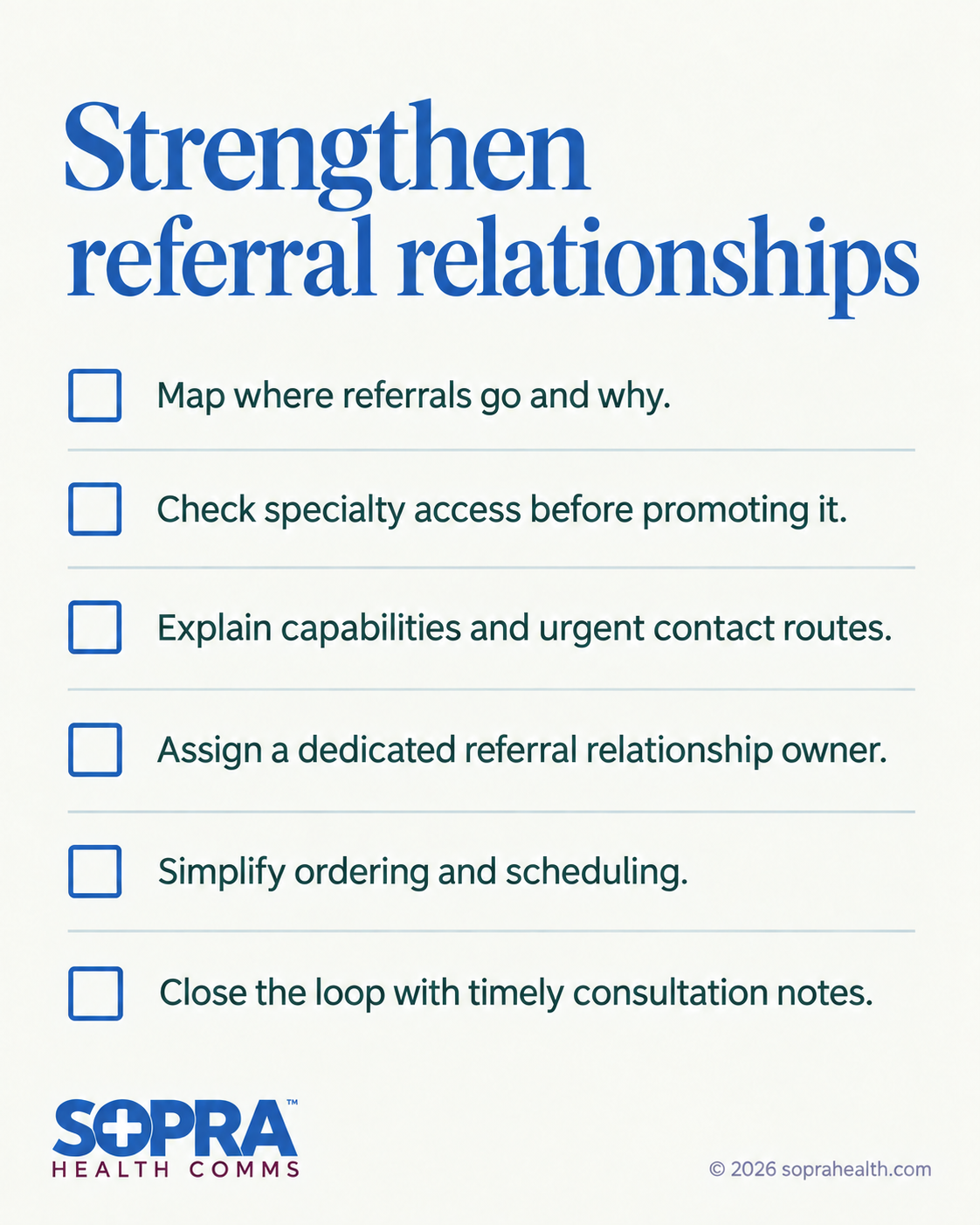
Awards and institutional distinctions have their place, usually on a wall or in an annual report. Referring physicians are more likely to care about matters with immediate consequences for their patients: how quickly an appointment can be secured, what conditions the specialist treats, whether the consultation note will arrive promptly, and whom to contact when a case is urgent or unclear.
This story must also be true in practice. If access is poor or communication routinely fails, promotion will not repair the problem. Operations must improve before messaging can credibly describe them.
Give the Relationship an Owner
Portals exchange information. People build confidence.
A liaison or dedicated referral lead can visit primary care practices, hear recurring frustrations, explain specialty capabilities, and connect clinicians who might otherwise remain names in the same directory. Specialists contribute by meeting their primary care colleagues, making themselves available for appropriate consultation, and returning calls consistently.
None of these actions is theatrical. That is part of their strength. Referral relationships are usually shaped through repeated evidence that cooperation will be easy and that the patient will be well received.
Make the Intended Choice the Easy Choice
Information asymmetry arises when one party—in this case, the specialist or specialty practice—knows more about appointment availability and standards of care than the referring clinician does. Without accessible information, even an excellent in-network specialist may remain effectively invisible.
The ordering and scheduling process must therefore do more than technically permit an internal referral. It should make suitable specialists easy to find, clarify what they treat, show meaningful access information, and provide a workable path to an appointment.
This is the last mile of referral management, and it is often where good intentions meet their end. If the electronic workflow is confusing or scheduling becomes a prolonged exchange, physicians will use the route that moves the patient forward. Usually, they will consider that the responsible choice.
The Opportunity Already in the System
Trust does not reorganize itself on command. Referral patterns form over time, and changing them requires repeated proof that a new pathway deserves to become habitual.
Once established, however, those patterns can be durable. A physician who knows that a colleague will respond, that an office will accommodate a patient appropriately, and that information will return after the visit has little reason to begin the search again.
Most health systems spend considerable sums introducing themselves to strangers. At the same time, physicians working within those systems may be sending patients elsewhere because another organization has been more attentive to the practical details of clinical partnership.
The strongest growth opportunity may therefore be sitting a few floors away, entering a familiar order into a familiar record and choosing the name that has earned the next measure of trust.
The Human Moment is Sopra Health’s essay series on the human side of healthcare growth — the patients, clinicians, and operators behind every human moment where healthcare and wellness decisions are made.
If you’re in need of help, tell us what challenge you’re facing. And if you’d like the next essay when it publishes, get the series by email. You can unsubscribe at any time.
Frequent questions about working together with Sopra Health Comms:
1. How do physicians decide where to send a referral?
Physicians prioritize reliable communication and frictionless handoffs because they are putting their own reputation on the line with every patient they send to a specialist. They rely on trust, personal connections, and ease of scheduling rather than corporate loyalty, often defaulting to the competitor who makes the process simple.
2. Why do internal referral systems often leak to outside competitors?
Leakage happens because health systems treat referrals as a compliance or “loyalty” issue rather than a relationship gap. When a primary care physician cannot get a timely response or a clear handoff, they naturally default to the outside specialist who is more attentive, effectively “borrowing” trust from that reliable relationship instead of the internal one.
3. What is “borrowed trust” in the context of specialist referrals?
Borrowed trust is a social phenomenon where a primary care physician transfers their professional reputation to a specialist. Because the PCP’s reputation is at stake, they vouch for a specialist based on their personal experience with that specialist’s responsiveness and care standards, rather than corporate mandates.
4. How can a health system stop referral leakage?
To fix the problem, treat internal doctors as an important audience by implementing a strategy that includes three steps: tell a better story focused on operational efficiency (wait times and communication), put a person in charge (a liaison to build relationships with PCPs), and simplify the ordering process. Focus on earning trust through reliable communication rather than sending stern memos.