
CATEGORY HERE
The HCP Dashboard Is Lying to You

By the third slide of the board meeting, paid search has acquired the reassuring authority of fact. It accounts for 61.2 percent of HCP enrollments. The figure is precise, the chart is immaculate, and the platform that produced both was expensive enough to have earned a presumption of competence.
No one asks what, exactly, the number means.
The budget follows it. Next quarter, if left undisturbed, the budget will follow it again.
Sopra Health senior consultants have seen versions of this slide make their way through dozens of rooms. The details vary, but the response is remarkably consistent: the more precise the attribution number appears, the less likely anyone is to question it. Marketing teams then develop a kind of attribution bias, reflexively rewarding the final recorded touchpoint regardless of its actual influence.
This would be a minor technical problem if the dashboard were merely imprecise. It is more consequential than that. The model is often measuring something quite different from what the team believes it is measuring.
The model is measuring the receipt
Last-click attribution was designed for a particular commercial environment: high-velocity e-commerce. It is a marketing measurement model that assigns 100 percent of the credit for a conversion to the final touchpoint a person encountered before taking action.
In the setting for which it was built, this can be a useful approximation. The consideration period may last only a few minutes. The person who sees the advertisement is generally the person who clicks, chooses, and pays. Much of the journey takes place within observable digital channels, from cookie to cart.
Healthcare decisions rarely conduct themselves with such tidy efficiency.
Consider what may happen when a physician evaluates whether to enroll patients in a digital therapeutic. The process may extend across a quarter or two. She is careful with her patients and feels no particular obligation to resolve the matter within the company’s fiscal calendar.
She may not be the sole decision-maker. A practice administrator could determine whether the workflow is feasible. A committee might need to review the program. Increasingly, a payer’s coverage decision may establish whether further consideration is worthwhile.
Then there are the influences that matter most and leave the faintest digital trace.
The physician encounters outcomes data during a conference session and makes a mental note of it. Later, she asks a specialty group whether anyone has practical experience with the therapeutic. A colleague she trained with offers a measured response: the program has been fine, though the onboarding is the weak point.
This is an example of “borrowed trust,” a social phenomenon in which credibility passes from a respected peer or expert to an unfamiliar product or service through direct recommendation. It is hardly a new feature of professional life, but it remains inconveniently resistant to campaign tracking.
At another point, the physician puts a specific question about a comorbid population to a medical science liaison and receives a direct, unpromotional answer. That exchange may matter more than every advertisement she has seen. In healthcare, information asymmetry—the condition in which one party possesses substantially more knowledge than another—can delay adoption until a trusted source helps the HCP evaluate what is known, what remains uncertain, and how the evidence applies in practice. A candid answer from a company is sufficiently uncommon that people tend to remember it.
Weeks later, the physician has made her decision. What she now needs is the enrollment link. She searches for the product by name and clicks the branded search advertisement at the top of the results because it is the first blue link.
The advertisement receives 100 percent of the credit.
There is the trick, performed without sleight of hand. The model has not measured persuasion. It has recorded the receipt.
The experiences that shaped the decision—the colleague’s qualified endorsement, the evidence presented in a credible professional setting, the direct answer to a difficult question—remain invisible precisely because they occurred between people. Branded search, in this kind of HCP journey, may function less as a source of demand than as a toll booth positioned near the journey’s end.
When a team increases paid-search spending because the channel “converts,” it may simply pay more to occupy the final step of a process created elsewhere. Meanwhile, conference activity, clinical evidence, peer exchange, medical engagement, and improvements to the enrollment workflow are asked to survive on whatever remains.
The obvious remedy appears to be better technology: multi-touch attribution, intent data, or a platform capable of stitching the journey together. Such tools can distribute credit more elaborately across observable digital interactions. The difficulty is that much of the decision has taken place beyond their field of vision.
A more sophisticated analysis of a partial dataset remains partial. What it adds is precision—and, in a boardroom, precision has a way of bringing a discussion to an end just when the discussion ought to begin.
Asking, testing, and reading the answers
The more reliable program is comparatively modest. A capable team can establish it within a quarter, and it rests on two disciplines: ask the people who made the decision, and test major spending against actual enrollment behavior.
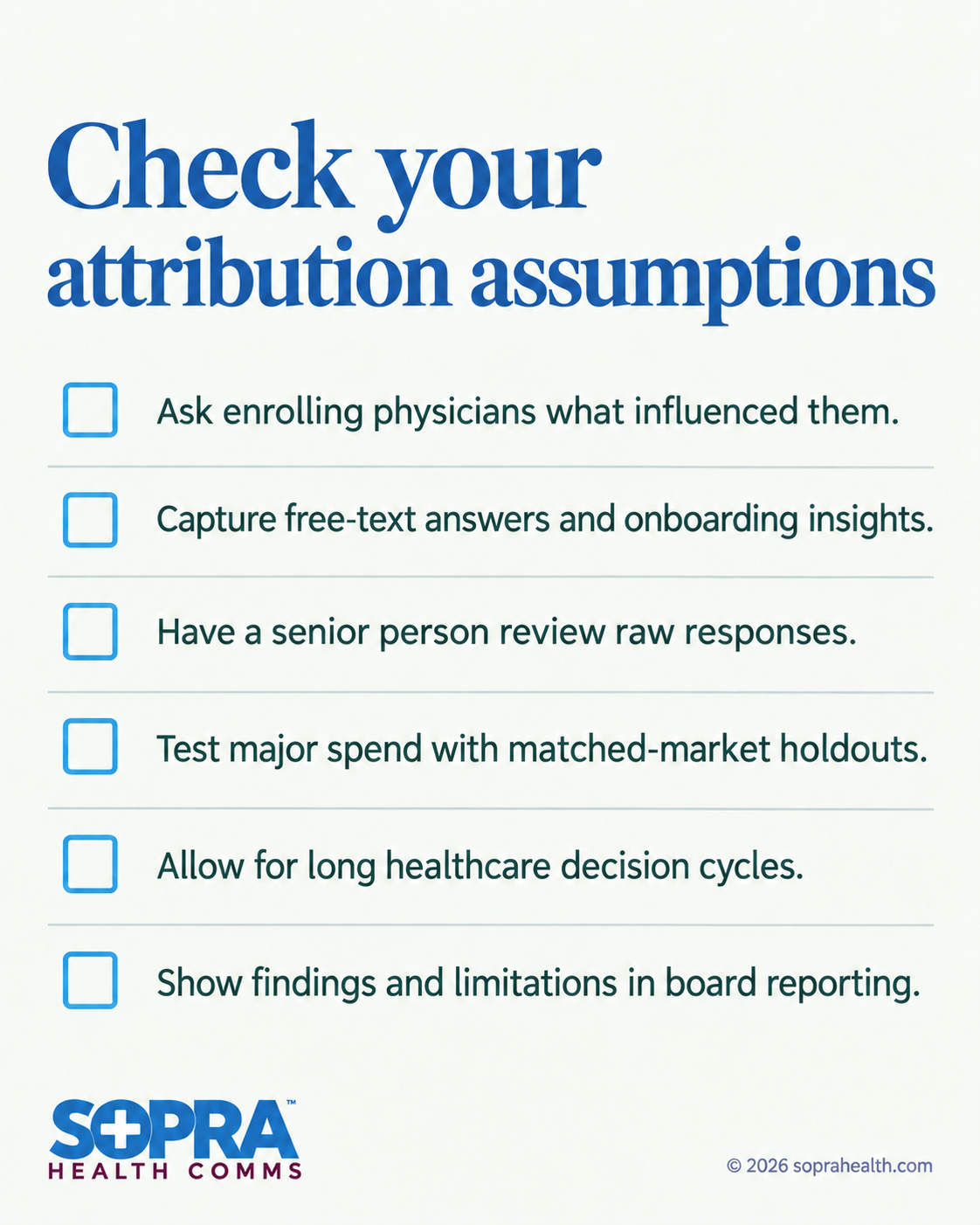
First, ask every enrolling physician how she heard about the offering.
A conventional dropdown menu is poorly suited to the task. It requires the physician to translate her experience into the channel categories preferred by the marketing system. A free-text field at enrollment provides more room for an honest answer, particularly when the same question is also asked during onboarding calls.
Someone senior should read those answers each month—not merely a summarized report, but the physicians’ actual words. After a few cycles, patterns are likely to emerge that the attribution dashboard never registered: the name of a colleague, a conference session, a care coordinator’s suggestion, a particular piece of evidence, or an exchange with a member of the medical team.
Self-reporting has limitations. People forget; they compress events; they tend to remember what was distinctive rather than what was frequent. But the purpose here is not to manufacture another decimal point. It is to understand the broad shape of the decision well enough to allocate resources intelligently.
The second discipline is geographic testing.
Select reasonably matched markets and suspend the largest spending line in several of them for six to eight weeks. Then observe what happens to enrollment. The design and interpretation of such a test require care, including attention to market differences and other activity occurring during the same period. Even so, it can offer evidence that an attribution model cannot.
Either result is useful. If enrollment remains stable in the markets where spending has paused, the team may have identified budget that can be redirected. If enrollment declines, the expenditure has acquired a more credible basis than its position as the final recorded click.
The board materials should change accordingly. In place of a channel-attribution slide offering certainty it has not earned, show the holdout results alongside a rolling account of what enrolling physicians actually reported. Describe the findings accurately: directional where they are directional, qualified where they require qualification, and useful because they are connected to observable behavior.
The evidence will look less immaculate. It may also be considerably more true.
The harder conversation
The principal obstacle is social rather than analytical.
In most meetings, a precisely wrong dashboard enjoys several advantages over a roughly right spreadsheet. The dashboard has a vendor logo, consistent colors, and no visible hesitation. The spreadsheet arrives with caveats. It requires someone senior to stand before the board and explain that the previous number was partly an artifact of a model developed for a different kind of commerce; that the newer evidence is less polished; and that the budget should nevertheless follow it.
This is not a glamorous responsibility. It is, however, one of the useful things senior judgment is for.
Teams that undertake this work often reach a similar conclusion. Their most effective “channel” was never quite a channel. It was a person whose judgment carried weight. A piece of evidence presented in the right setting. A straightforward response to a difficult question. A workflow that did not turn agreement into an administrative endurance test.
Once those influences become visible, the budget conversation changes. Media mix remains relevant, but it no longer occupies the whole field. The discussion moves toward how professional trust is established, transferred, tested, and maintained—and toward the practical conditions that allow a physician to act on that trust.
These matters take longer to understand and are harder to arrange neatly on a slide. Yet they are where healthcare decisions have been occurring all along: in conference rooms and group conversations, in careful questions and unvarnished answers, in the long interval between first attention and final action.
The dashboard sees the click at the end. The work is to understand everything that made the click possible.
The Human Moment is Sopra Health’s essay series on the human side of healthcare growth — the patients, clinicians, and operators behind every human moment where healthcare and wellness decisions are made.
If you’re in need of help, tell us what challenge you’re facing. And if you’d like the next essay when it publishes, get the series by email. You can unsubscribe at any time.
Frequent questions about working together with Sopra Health Comms:
1. Why are traditional HCP attribution dashboards almost always wrong when measuring healthcare enrollment metrics?
Traditional HCP attribution dashboards are fundamentally inaccurate because they rely on last-click attribution models designed for high-velocity, single-decision-maker e-commerce cycles. In healthcare, the decision to enroll is a slow, multi-stakeholder journey (involving physicians, practice administrators, and payers) that takes place over months and is heavily influenced by untrackable, human-driven analog interactions rather than digital clicks.
2. What is marketing attribution bias, and how does last-click attribution cause it in healthcare marketing?
Marketing attribution bias occurs when marketing teams reflexively allocate budget to the final recorded touchpoint regardless of its true impact. Because last-click attribution assigns 100% of the credit to the last interaction—such as a physician searching for a product name to find the enrollment link—it ignores the invisible, offline moments that actually built professional trust, such as peer recommendations or medical science liaison (MSL) engagement.
3. What is “borrowed trust” in the HCP patient journey, and why is it invisible to tracking dashboards?
Borrowed trust is a social phenomenon where credibility is transferred from a respected peer or expert to a new, unfamiliar product or service through a direct recommendation. In patient journey measurement, these offline interactions (like a trusted colleague’s endorsement in a group chat or an honest answer from an MSL) are what actually persuade physicians. Because they occur in analog, face-to-face, or private spaces, they remain completely invisible to digital tracking tools.
4. What are more reliable methods for measuring HCP enrollment and patient journey behavior than digital dashboards?
Instead of relying on digital tracking tools that offer false precision, healthcare commercial teams should implement two practical disciplines:
- Direct Physician Self-Reporting: Add a free-text field at enrollment and ask “How did you hear about us?” during onboarding calls. Reading the actual, raw sentences monthly helps map the true shape of the decision.
- Geographic Holdout Testing: Select matched markets and suspend your largest digital advertising spend line in some of them for six to eight weeks. Observing the actual drop or stability in healthcare enrollment metrics provides definitive ground truth of channel impact.