
CATEGORY HERE
The Campaign That Won 20 Markets and Lost 40 in the Process

A national campaign usually arrives with the reassuring completeness of a matched set. The photography is polished. The language has survived several conference rooms. The presentation closes with a map on which every market appears equally reachable, each one marked by a tidy dot and the tacit assumption that patients everywhere will respond in roughly the same fashion.
Then the results arrive.
In 20 markets, the campaign performs beautifully. Appointments rise. Phones ring. Growth charts acquire their preferred direction. In 40 others, very little happens—or something worse does. Patients click, encounter an obstacle, and discover that the action urged by the advertisement is unavailable to them.
This is the point at which a marketing problem often becomes an organizational one. Headquarters questions the enthusiasm or execution of local teams. Local managers describe the national campaign as foreign to their markets, perhaps even tone-deaf. The creative team defends the work, usually with some justice. Everyone has evidence. Everyone also has a budget meeting on Thursday.
Yet the most important explanation may lie elsewhere. The campaign has treated a collection of healthcare markets as though they shared the same rules for entering care. They do not.
The decisive variation is often neither demographic nor geographic. It is structural. Patients in one market may contact a provider directly and schedule an appointment. Patients in another may first need a referral, authorization, or other approval shaped by clinical practice, payer policy, or local operating arrangements. The same advertisement can therefore function as a useful invitation in one place and an instruction to approach a locked door in another.
At Sopra Health, we regard effective marketing as a matter of alignment rather than volume: the message has to correspond with the patient’s actual route into care. A campaign cannot produce consistent results when the action it requests is available to some patients and effectively unavailable to others.
The Doorway Matters
Healthcare markets are commonly organized on maps. Patients, however, experience them through doorways.
In a direct-access market, a person may be able to call, complete an intake, book an appointment, or enter care without first securing a referral. Here, the patient possesses a meaningful degree of autonomy. A well-designed “Call Us Now” or “Book Today” campaign can work because the distance between intention and action is short. The advertisement proposes a next step, and the patient can take it.
In a referral-required market, the sequence is different. The patient may first need to speak with a primary care clinician or another authorized professional, obtain a referral, satisfy a payer requirement, or navigate an approval process. A direct-response advertisement does not remove these conditions. It merely delivers the patient to them more quickly.
The resulting frustration is easy to underestimate. The advertisement has implied that an appointment is one click or phone call away. The system then explains that it is not. What appears on a dashboard as an abandoned conversion may have been a person making a reasonable attempt to follow instructions that did not fit the conditions of care.
This does not mean direct-access markets are simple or that referral markets are uniform. Insurance design, provider capacity, benefit rules, scheduling practices, transportation, language access, and local referral relationships can all alter the path. The useful distinction is not between easy markets and difficult ones. It is between markets in which the requested action matches the patient’s authority and markets in which another participant must act before care can proceed.
A single campaign deployed across both structures may be administratively convenient. Strategically, it asks one message to perform two different jobs. Its uneven results should not be surprising.
A More Useful Map
The remedy begins with a different kind of market analysis.
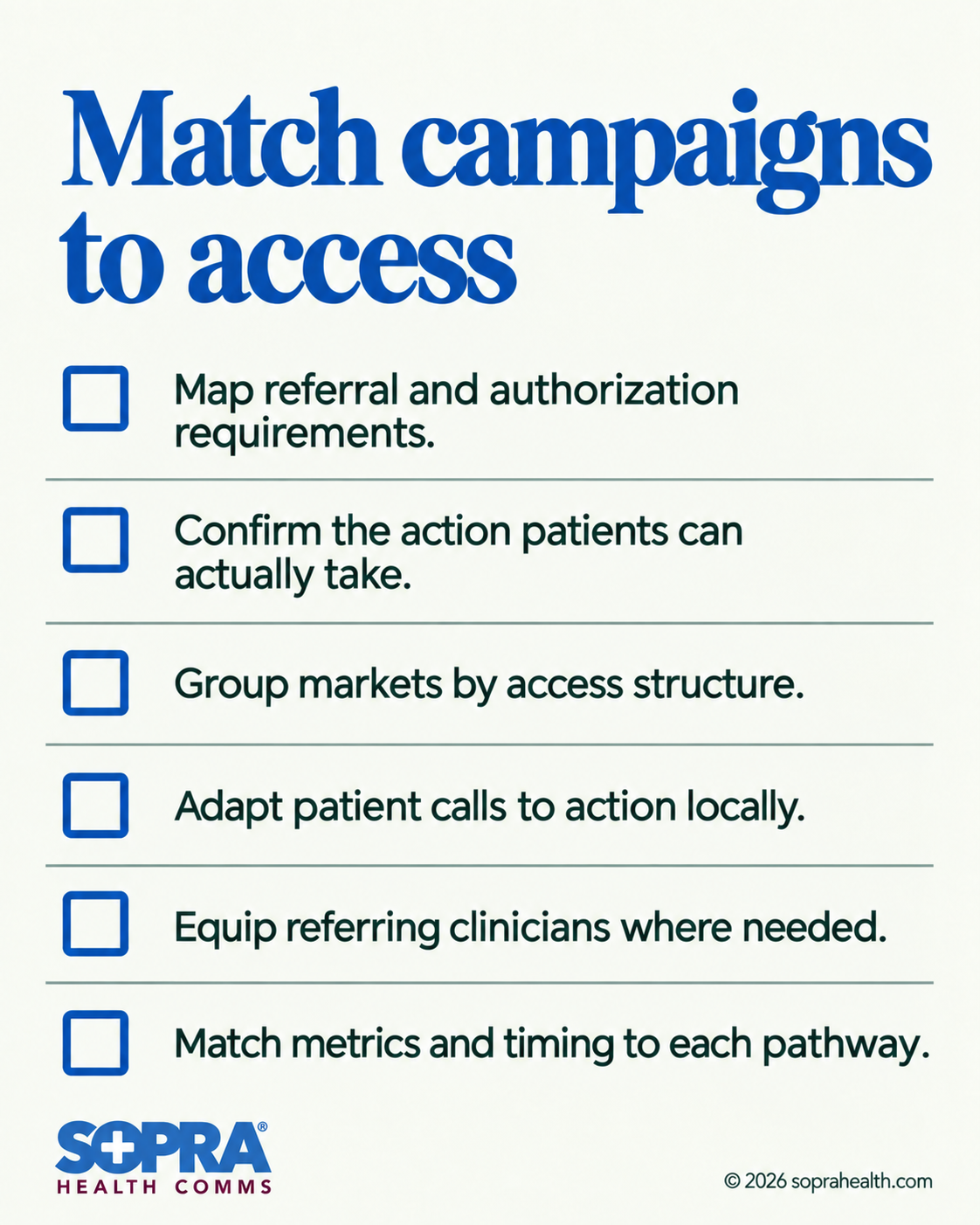
Rather than classifying locations principally by region, population, or media boundary, healthcare organizations can map them according to the mechanics of access. This requires a disciplined review of referral practices, payer requirements, authorization rules, provider relationships, and the practical steps a patient must complete before receiving care.
Once the familiar map is set aside, an apparently complicated national footprint may resolve into a small number of recurring access structures. The particulars still matter, but the strategic problem becomes more manageable. Markets that look distant from one another geographically may operate in much the same way. Neighboring markets may not.
In Sopra Health’s consulting experience, this form of structural data mapping—organizing markets by the way patients enter care rather than by location alone—has been especially valuable in explaining differences in campaign performance and directing investment more intelligently.
The next step is to build a family of related campaigns rather than insist upon a single national execution.
Direct-access markets can support consumer communications designed to prompt immediate action. Referral-dependent markets generally require a more patient and coordinated approach. Patient-facing materials can help people understand the appropriate next step and prepare them to discuss the service or treatment with a clinician. At the same time, professional outreach can give referring clinicians the information they need to assess its relevance, credibility, and value.
These communications should belong to the same family. They may share a visual identity, central proposition, and standard of evidence. But they should not pretend that every audience holds the same information, occupies the same role, or possesses the same authority.
That distinction matters in healthcare, where information is rarely distributed evenly. Providers ordinarily know more than patients about treatment criteria, referral processes, and the inner workings of the system. Patients know more about the realities of their own lives, including what they can afford, arrange, understand, or sustain. Effective communication respects both kinds of knowledge. It does not mistake enthusiasm for access.
Time Is Part of the Strategy
Different access paths also produce results on different schedules.
A direct-response campaign may generate calls, inquiries, or bookings within weeks. A referral strategy depends upon professional awareness, confidence, repetition, and the appearance of an appropriate patient. Its effects may emerge over months or quarters.
Placing both strategies on one undifferentiated dashboard creates a peculiar illusion: the faster pathway appears effective because it reports sooner, while the slower pathway appears ineffective because it is still underway. Leadership may then discontinue a sound referral effort for failing to behave like an advertisement designed for immediate booking.
Last-click attribution compounds the problem. By assigning all conversion credit to the final recorded interaction, it can conceal the sequence of patient education, clinician consideration, referral, authorization, and scheduling that preceded it. The final click is visible. The months of human judgment behind it are less cooperative.
Measurement should therefore reflect the access structure. Direct-access campaigns may reasonably be assessed through inquiries, appointments, conversion rates, and near-term acquisition costs. Referral strategies may require indicators such as clinician engagement, referral activity, progression through authorization, patient readiness, and eventual treatment initiation. The precise measures will depend on the service and market, but their timing should correspond to the work the campaign is actually doing.
Three Terms Worth Keeping Straight
An access path is the clinical and structural route through which a patient enters a provider’s system. It may range from direct booking to a sequence involving referral, authorization, eligibility review, or other requirements.
Information asymmetry describes a condition in which one participant possesses substantially more information than another. In healthcare, providers often have greater knowledge of treatment criteria and system navigation, while patients may be left to make consequential decisions with only a partial view of the process.
Last-click attribution is an analytics model that assigns conversion credit to the final recorded touchpoint. In referral-dependent healthcare journeys, it can provide an incomplete account because many influential interactions occur earlier, over a longer period, or outside the systems used to track marketing activity.
The Intelligence of Fit
Structural segmentation asks more of an organization. It requires better data, closer cooperation among national and local teams, multiple campaign pathways, and a budget capable of acknowledging that uniformity and efficiency are not always the same thing.
Even so, this complexity is less costly than repeatedly inviting patients to take actions the healthcare system will not permit them to complete. The financial waste is considerable. The human consequence is quieter: another unanswered call, another confusing instruction, another small reason to distrust a system already rich in them.
The campaign that succeeds in 20 markets and fails in 40 has not necessarily uncovered 40 weak markets. Nor has it necessarily exposed poor local execution. It may simply have revealed, with unusual expense, that patients cannot enter every part of the healthcare system through the same door.
A message earns its place when the person receiving it can do something sensible with it. The national map may remain on the boardroom wall, its dots as orderly as ever. The more useful map begins closer to the ground—with the patient, the next step, and whether the door described in the advertisement is truly there.
The Human Moment is Sopra Health’s essay series on the human side of healthcare growth — the patients, clinicians, and operators behind every human moment where healthcare and wellness decisions are made.
If you’re in need of help, tell us what challenge you’re facing. And if you’d like the next essay when it publishes, get the series by email. You can unsubscribe at any time.
Frequent questions about working together with Sopra Health Comms:
1. Why do national healthcare marketing campaigns fail in local markets?
National marketing campaigns fail in local markets because they ignore structural variations in how patients access care, treating diverse regions as a single, homogenous entity. When a campaign requests an action that is available in some areas but structurally blocked in others, it leads to wasted budget, organizational friction, and patient frustration.
2. What is the difference between direct-access and referral-required healthcare markets?
- Direct-Access Markets: In these markets, patients have the autonomy to book appointments, complete intakes, or walk in without an intermediary. Direct-response campaigns like “Call Us Now” or “Book Today” are highly effective because the friction between intent and action is minimal.
- Referral-Required Markets: These systems are gated, requiring patients to first see a primary care clinician or secure a referral or authorization. Direct-response ads here are often confusing or frustrating because patients cannot legally or financially complete the requested action without prior clinical steps.
3. How does structural data mapping improve local campaign ROI?
Structural data mapping organizes markets based on the entry mechanics of patient access rather than geographic boundaries. By classifying markets into recurring access structures, healthcare organizations can build targeted “Campaign Families” (e.g., direct-access consumer messaging vs. dual-track physician and patient education for referral markets) to ensure marketing investments match actual access pathways.
4. What is an access path in healthcare marketing?
An access path is the clinical and structural route through which a patient enters a provider’s system. This mechanism ranges from direct booking by the patient to a complex, multi-step sequence involving referrals, clinician reviews, and health plan authorizations.
5. How does last-click attribution mislead healthcare marketers?
Last-click attribution is an analytics model that gives 100% of the conversion credit to the final touchpoint (like a click or call). In referral-heavy healthcare environments where patient journeys can take months, this model is highly misleading because it conceals the critical sequence of patient education, clinician trust-building, and referral coordination that occurred prior to the final action.
6. What is information asymmetry in healthcare communication?
Information asymmetry refers to a condition where one participant has significantly more information than another. In healthcare, providers often possess greater knowledge of treatment necessity and system mechanics, while patients hold key insights into their personal circumstances. Effective communication must respect both domains rather than assuming the patient knows how to navigate the system.