
CATEGORY HERE
Your Founding-Era Positioning Deck Is Tired

You are still telling a year-one story
Certain presentations enjoy a surprisingly long institutional life. They survive leadership changes, strategic plans, and several rounds of rebranding. A new photograph appears on the cover. The font becomes more contemporary. Someone updates the provider count. Yet the story underneath remains exactly where it began.
For a multispecialty network approaching its most consequential payer renegotiation, that story often dates from the founding era. It contains the familiar evidence of arrival: provider totals, service lines, geographic coverage, perhaps a map decorated with enough pins to suggest both reach and inevitability.
There was a time when these facts answered the essential questions. Does this organization truly exist? Can it offer meaningful access? Is it large enough to warrant attention?
Nine months before a major negotiation, however, existence is no longer the matter under discussion.
The network has matured. The buyer’s expectations have changed. Yet the deck continues to make a year-one argument: we are here, we are growing, and we cover a respectable portion of the map. All of which may be true. None of it necessarily helps secure favorable terms.
This is easily misdiagnosed as a slide problem. The materials look dated, so the natural prescription is cleaner graphics, fewer words, perhaps a spirited new shade of blue. A month before the meeting, the deck is polished and returned to service with the hopeful air of a hotel lobby after new carpeting.
But design cannot supply leverage that the underlying narrative does not contain. The cost of an old story is measured less in aesthetics than in the strength of the case a negotiator can make with it.
Provider counts and coverage maps may establish scale. They rarely explain why better rates are justified.
The person across the table has a room behind her
“The payer” is convenient shorthand. It is also misleadingly impersonal. Across the table sits an actual person with a title, a manager, a set of performance expectations, and a committee that may review the consequences of her decisions long after the meeting has ended.
Her job is not simply to admire the network’s growth. Depending on the organization and contract, she may be evaluating access, outcomes, utilization, cost performance, competitive position, member experience, or some combination of all five. A favorable agreement will eventually require an internal explanation.
That changes the practical purpose of positioning materials.
The question she needs answered is not merely, “How large is this network?” It is closer to: “What case can I take back to my colleagues that makes these terms defensible—and will the evidence survive analysis?”
A map cannot answer that question on its own. Nor can a page announcing thirty providers, however tastefully arranged. If the network says little about outcomes, the buyer is unlikely to interpret the silence as modesty. She may conclude that the organization does not measure performance consistently, has not identified a meaningful advantage, or would prefer that no one examine the data too closely.
Uncertainty has a way of acquiring a price. In contracting, assigning one to it is part of the job.
Effective positioning materials therefore have to do something more demanding than recount the organization’s history. They should provide a clear, evidence-supported business case that a payer representative can understand, test, and carry into internal deliberations.
Most networks possess more material for such a case than their presentations suggest. Clinical and claims data may reveal favorable readmission patterns, emergency department avoidance, or service lines that perform well against an appropriate benchmark. The difficulty is often neither a complete absence of results nor a shortage of intelligent people. It is that assembling the story belongs to everyone in principle and no one in particular.
The data remain in separate systems. Analysts understand one portion, clinical leaders another, and the contracting team remembers an encouraging anecdote from a meeting six months ago. When urgency finally arrives, these fragments are gathered with considerable energy and very little time.
In Sopra Health’s work with healthcare organizations, placing network performance in the context of relevant market benchmarks can help move the discussion beyond price per unit toward value across an episode of care. But data do not become persuasive merely because they have been exported into PowerPoint. They must be examined, pressure-tested, qualified, and shaped into a narrative that remains credible when the payer’s analysts begin asking less decorative questions.
Positioning assembled in month eight carries the unmistakable character of month eight: hurried, defensive, and rather too pleased with whatever evidence happened to be readily available.
The advantage of beginning before anything is on fire
Nine months offers something healthcare organizations seldom have in abundance: time to discover what is actually true.
That matters because contracting contains a persistent information imbalance. Each side holds knowledge the other cannot fully see—about performance, priorities, alternatives, constraints, and appetite for risk. When a network has not developed a disciplined account of its own value, it enters that imbalance at an avoidable disadvantage. The payer will still arrive with assumptions. The network will simply have done less to influence them.
Early narrative work is not a large new department or an elaborate campaign. It is a focused strategic effort, begun while there is still time for the findings to affect more than the wording of a slide.
The first task is to mine the data honestly. Where does the network genuinely outperform? Against which comparison group? Over what period? With what qualifications? Where is performance less persuasive, and can that weakness be improved, explained, or placed in the proper context?
A case that survives diligence is more useful than ten claims that flatter the organization. Beginning nine months ahead allows leaders to investigate an apparent weakness and perhaps act on it. Beginning one month ahead allows just enough time to make the footnote smaller.
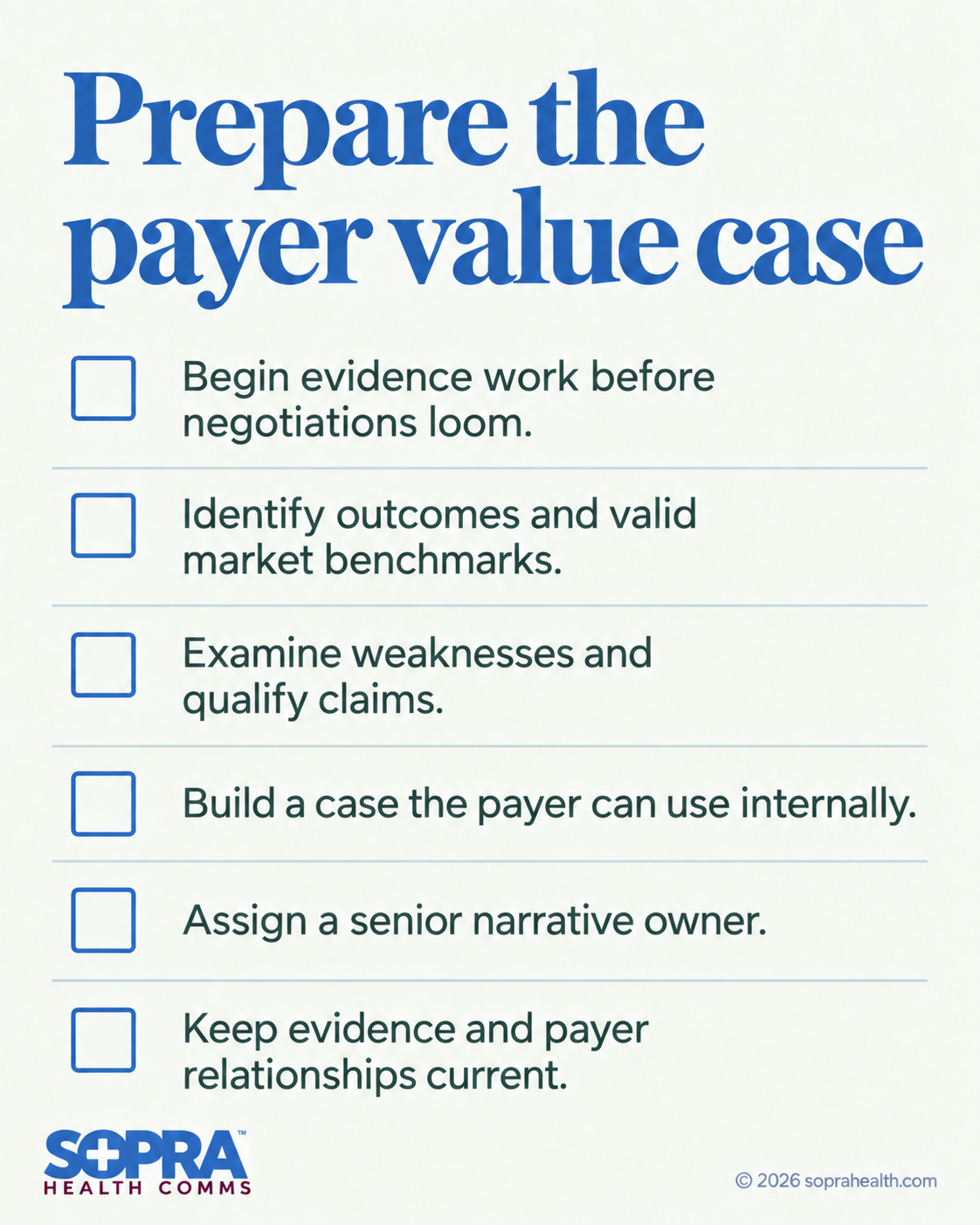
The second task is to create materials the payer representative can use. A conventional brochure asks the buyer to admire the organization. A strong positioning case helps her explain the organization to other people.
That distinction should govern every page. Does this evidence clarify the decision? Does it anticipate the committee’s concerns? Is the comparison valid? Can the central point be lifted into an internal memorandum without extensive repair? Does the material make the representative’s position more informed and more defensible?
The most valuable pages may continue working in rooms the network’s own leadership will never enter.
The third task is to give the narrative an owner. Ownership need not mean another department, another committee, or a new vice president whose first contribution is an organizational chart. It may require only a fraction of a senior role: one person accountable for keeping the evidence current, aligning the story with contracting priorities, and ensuring that those who represent the network understand both the claims and their limits.
This owner can also help maintain the relationship between formal negotiations. Sharing relevant outcomes with payer medical directors over time allows the network’s performance to become familiar before terms are under discussion. The credibility gained through validated results, credible benchmarks, and trusted third parties functions as a form of borrowed trust. It cannot substitute for performance, but it can help performance travel farther.
Marketing has its own cautionary example in last-click attribution, which assigns disproportionate credit to the final interaction before a result. Contracting teams can make a similar mistake by treating the negotiation meeting as the event that produced the agreement. By then, much of the consequential work has already occurred: the evidence has been selected, the weaknesses have been encountered, the relationships have developed, and the buyer has formed an opinion about whether the organization understands its own value.
The meeting is merely where those accumulated judgments become visible.
None of this guarantees ideal terms. Payer negotiations remain shaped by market power, network adequacy, competition, utilization, policy, financial constraints, and many other considerations that no positioning deck can charm out of existence. A disciplined narrative does, however, alter the quality of the conversation. The network arrives with evidence rather than adjectives. The buyer has material she can use. Both parties can spend less time establishing whether the story is credible and more time deciding what it means.
People listen differently to a counterparty who has made the decision easier to evaluate.
The deck was never for you
Founding-era decks are often affectionate documents. They commemorate what the organization built, how far it has reached, and how many people now appear beneath the logo. Leaders recognize themselves in that story, which may explain why it survives long after its negotiating usefulness has faded.
A payer positioning deck has a different audience and a less ceremonial obligation. Its purpose is to help another person make, explain, and defend a consequential decision.
That requires a measure of institutional maturity. The network must be willing to replace self-description with evidence, familiar boasts with meaningful comparisons, and the comfort of its own history with the harder question of what matters to the person across the table.
Nine months before the negotiation, there is still time to ask that question properly. There is time to locate the proof, understand its limits, improve what can be improved, and build a case that another person can carry into the room behind the room.
By the time everyone sits down at the table, the deck should feel almost unsurprising. The most persuasive parts of the negotiation will already have taken place.
Technical Meta Data
- Meta Title: Healthcare Payer Negotiation Strategy | Sopra Health Insights
- Meta Description: Stop using outdated positioning decks. Learn how to leverage data-backed storytelling to secure favorable contract terms and win with your payer.
- Canonical URL: [link removed]/healthcare-payer-negotiation-strategy
- Primary AEO Target Keywords:
- healthcare payer negotiation strategy
- multi-specialty network positioning
- healthcare data storytelling
- provider contracting leverage
- payer negotiation insights
The Human Moment is Sopra Health’s essay series on the human side of healthcare growth — the patients, clinicians, and operators behind every human moment where healthcare and wellness decisions are made.
If you’re in need of help, tell us what challenge you’re facing. And if you’d like the next essay when it publishes, get the series by email. You can unsubscribe at any time.
Frequent questions about working together with Sopra Health Comms:
1. What is the most effective healthcare payer negotiation strategy for provider networks?
A successful healthcare payer negotiation strategy focuses on moving beyond year-one scale metrics—like provider counts and map pins—to deliver a data-backed business case. By aligning your narrative with the payer representative’s internal committee incentives, you provide the evidence needed to justify and defend favorable contract terms.
2. How does multi-specialty network positioning need to change after the founding era?
Early multi-specialty network positioning is designed to prove existence and basic geographic coverage. To secure favorable rates in mature cycles, positioning must transition from proving scale to demonstrating clinical performance, operational efficiency, and value per episode.
3. What role does healthcare data storytelling play in provider contracting leverage?
Healthcare data storytelling translates raw clinical and claims data into persuasive, benchmarked narratives (such as ED avoidance and readmission reductions). Rather than relying on simple anecdotes, this structured approach builds provider contracting leverage by demonstrating cost performance directly to the payer’s analysts.
4. Why are traditional payer negotiation insights failing to secure competitive rates?
Traditional payer negotiation insights that prioritize size over outcomes fail because payers are incentivized to buy value, not volume. When networks remain silent on their outcomes, payers price that performance uncertainty directly into the contract, resulting in unfavorable rate terms.