CATEGORY HERE
The People Who Already Know the Way

Every specialized treatment arrives in the world carrying two histories. The first belongs to the innovation itself: the years of research, clinical evidence, regulatory review, protocol design, and careful argument. The second begins only when someone encounters it—a clinician between appointments, a caregiver reading after an already long day, a patient trying to determine what this new possibility might mean for an ordinary Tuesday.
Between those histories lies one of the central difficulties in high-niche healthcare marketing: information asymmetry.
The term sounds almost tidy. The experience rarely is. A company may possess a formidable command of the science while the person receiving its message has limited time, uneven context, and reasons—cognitive, emotional, practical, or historical—to proceed carefully. The problem is seldom a simple shortage of information. More often, it is an imbalance between the complexity being presented and the conditions under which another human being is expected to understand it.
Conventional marketing machinery is poorly suited to this circumstance. Generic retargeting, automated email sequences, and lifestyle language may create additional encounters with a message, but repetition does not necessarily produce comprehension. Urgency can be especially unhelpful. A clinician who detects simplification may become skeptical; a patient or caregiver who feels hurried may stop altogether. What appears on a dashboard as inactivity may, from the other side, be the sensible exercise of caution.
This is where reach is frequently mistaken for influence.
A broad digital audience can be purchased. Credibility cannot. Yet traditional media plans often allocate substantial resources to health-and-wellness personalities whose principal qualification is their ability to gather attention at scale. For people living with rare, complex, or highly sensitive conditions, sponsored content is usually easy to recognize. Many have developed an alert eye for it, through professional training, personal experience, or both. The advertisement may be polished, properly targeted, and entirely compliant. It may also be dismissed before it has had the opportunity to explain anything of consequence.
High-niche healthcare depends upon a different kind of messenger: someone whose standing was established before the brand appeared.
Such people are found throughout local health ecosystems. They may be support-group leaders, retired nurses whom neighbors consult, leaders of community-based organizations, or clinicians who have become regional points of reference. Their authority does not derive from follower counts. It has accumulated through consistency—through being present, useful, informed, and accountable over time.
That history creates what may be called borrowed trust: the carefully governed introduction of unfamiliar information through a relationship that is already trusted.
The phrase requires some precision. Trust is not transferred like a mailing list, nor does a community advocate confer clinical validity merely by speaking. The evidence supporting an innovation must remain capable of standing on its own. What the trusted local figure can provide is a credible beginning: a reason to listen, a setting in which questions may be asked without embarrassment, and a path through information that might otherwise feel remote or forbidding.
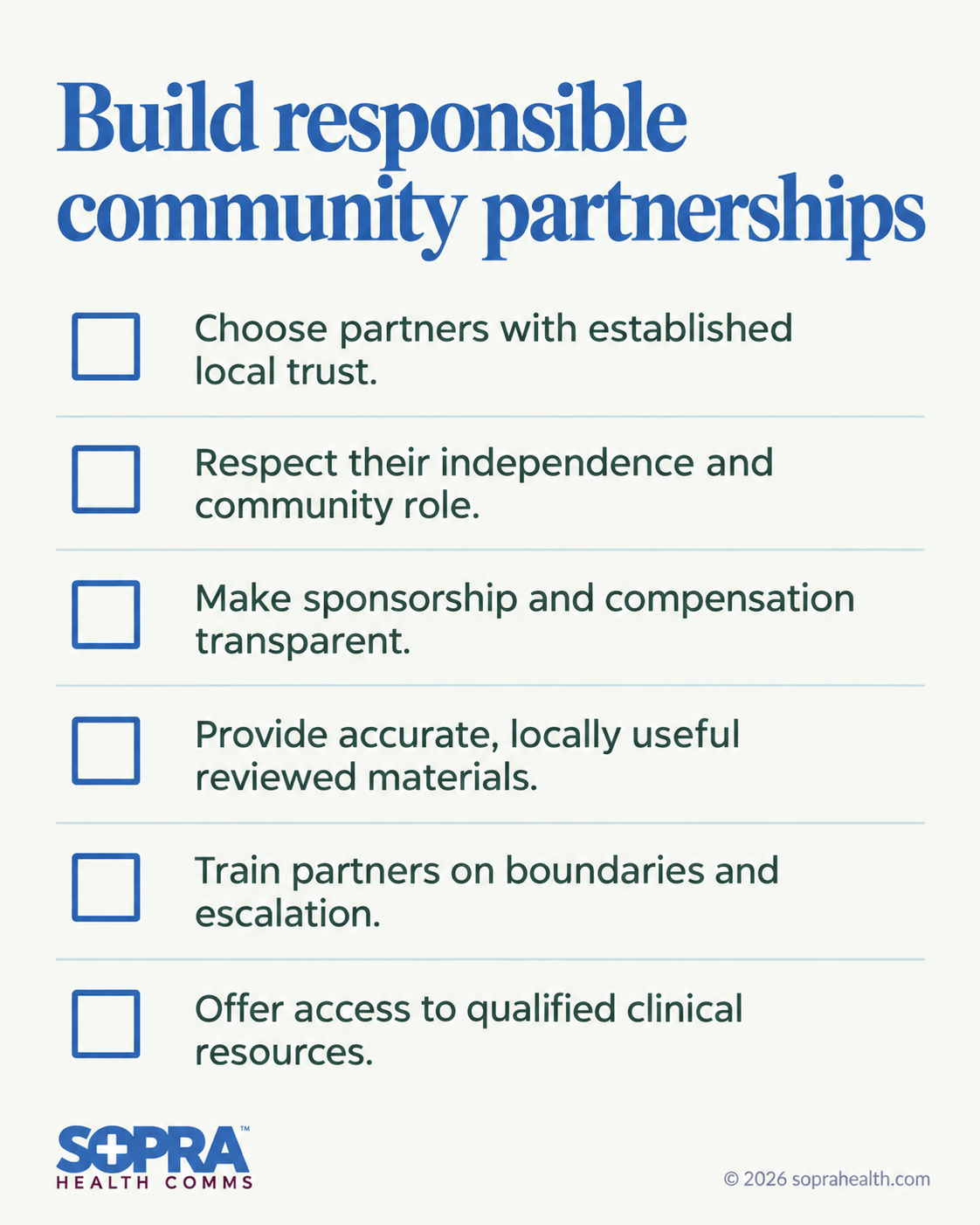
This is also why the relationship cannot be treated as a disguised media purchase. Community leaders are not local distribution channels waiting to be activated. Their credibility belongs to them and to the communities in which it was earned. A responsible partnership respects that independence, compensates people fairly for legitimate work, makes sponsorship transparent, and establishes clear boundaries around what may and may not be said.
The practical infrastructure matters. Centrally developed materials can help preserve clinical accuracy and meet applicable legal, regulatory, and review requirements. Local customization can make those materials intelligible and culturally appropriate. Flexible, pre-cleared talking points may allow a community partner to speak naturally without wandering into unsupported claims or individualized medical advice. Training, escalation procedures, and accessible routes to qualified clinical resources complete the structure.
In this model, the work moves along two paths at once. The brand supplies validated information, compliant materials, and operational support. The community anchor supplies context, language, and a relationship in which the information can be considered. Neither substitutes for the other. Together, they may reduce the distance between the existence of an innovation and a person’s ability to make an informed decision about it.
For Sopra Health, the commercial significance follows from that human reality. When hesitation arises from complexity, unfamiliarity, or mistrust, greater message volume is a blunt instrument. A more durable approach is to support the people and institutions that communities already turn to—without appropriating their authority or compromising their independence.
Trust built over years should never be taken for granted. Properly respected, it can offer something even a technically impeccable campaign cannot manufacture: a credible place for the understanding to begin.
The Human Moment is Sopra Health’s essay series on the human side of healthcare growth — the patients, clinicians, and operators behind every human moment where healthcare and wellness decisions are made.
If you’re in need of help, tell us what challenge you’re facing. And if you’d like the next essay when it publishes, get the series by email. You can unsubscribe at any time.
Frequent questions about working together with Sopra Health Comms:
1. How can healthcare organizations overcome information asymmetry in patient communications?
Healthcare organizations can overcome information asymmetry in patient communications by shifting from transactional, hyper-automated marketing to relationships rooted in “inhabited credibility.” Instead of relying on generic digital ads that alienate skeptical audiences, brands should partner with trusted, local community advocates—such as support group leaders and retired nurses. Providing these anchors with compliant, customizable toolkits allows them to share validated clinical insights in their native voice, bridging the knowledge gap and easing patient hesitation.
2. What is the difference between a health ambassador and a health influencer?
The primary distinction lies in how their credibility is established and sustained:
- Health Influencers utilize “rented influence” to broadcast sponsored content to broad, generalized social audiences. This transactional method is often easily spotted and dismissed by patients managing complex or rare diseases.
- Health Ambassadors (or community anchors) possess “inhabited credibility” earned through sustained, local presence, accountability, and direct clinical or community support. Their influence is rooted in trust rather than follower metrics.
3. What are the best practices for building patient community trust in niche healthcare markets?
Building authentic trust within rare or niche patient communities requires:
Partnering with Earned Credibility: Collaborating with established local leaders who already possess deep, unshakeable community trust.
Respecting Partner Independence: Protecting the unique voice and autonomy of local advocates rather than treating them as standard advertising channels.
Providing Compliant Infrastructure: Equipping advocates with centrally approved, legally compliant talking points that can be adapted to fit local cultural contexts.
Maintaining Radical Transparency: Fully disclosing sponsorships and compensating community leaders fairly for their expertise.
4. How does borrowed trust work in healthcare marketing?
In healthcare marketing, “borrowed trust” refers to the authoritative transfer of credibility that happens when a clinical innovation is introduced to a patient or clinician by a trusted local advocate. Because the relationship with the advocate is already established, their validation of the treatment helps bypass initial skepticism and emotional barriers, allowing the scientific evidence to be heard and understood.
5. Why is authentic healthcare engagement more effective than high-volume digital outreach?
High-volume digital campaigns often fail because repetition does not equal comprehension; clinical audiences and rare-disease patients are highly trained to filter out promotional clutter. Authentic healthcare engagement is more effective because it operates through local relationships where complex clinical information can be discussed in a safe, relatable, and culturally appropriate environment, leading to informed decisions and stable long-term enrollment.