
CATEGORY HERE
You Tripled Content Output with AI, and Engagement Fell

The Quarter the Machine Got Faster
There is a particular kind of satisfaction in opening a content calendar and finding November already taken care of.
Not merely sketched in, either, but fully provisioned: articles drafted, emails multiplied into variants, LinkedIn posts standing neatly in their assigned squares. A growth team that once required a week to produce a blog post can now finish one in a day. Generative AI has moved beyond the experimental stage and into the working life of the organization. The process is faster. The backlog has diminished. The machinery, at last, appears to be doing precisely what was promised.
Then comes the quarterly review.
Open rates are down. Click-throughs are down. Time on page is down. Physician engagement with the HCP content—the measure the program was built to improve—is down as well. Nothing has collapsed dramatically. The figures have simply begun to sag, one after another, during the same quarter in which output tripled.
This pattern has become familiar enough to deserve attention. It is usually met first with practical explanations: the prompts need refining, the channel mix needs adjusting, the subject lines require another round of testing. Such explanations are comforting because they imply a tune-up rather than a reconsideration.
But the more consequential problem may sit beneath the production system itself.
At Sopra Health, we think of engagement as a trust-side equation, not a supply-side one. The distinction matters because healthcare organizations recovering from AI-content fatigue will not do so by making generic content somewhat better. Recovery begins when volume ceases to be the governing ambition and a distinct, defensible point of view—one grounded in specific clinical realities—takes its place.
The Twenty Unclaimed Minutes
The case for content velocity usually rests on an assumption so ordinary that nobody bothers to put it on a slide: the audience would engage more if only it received more material.
Information asymmetry—the condition in which one party possesses more or better information than another—can contribute to failures in healthcare communication. Yet the problem facing many healthcare audiences today is not simply a shortage of available information. It is the difficulty of deciding which information deserves attention.
Consider the physician at the other end of the distribution list. She may have twenty unclaimed minutes in a clinical day, though “unclaimed” is perhaps a generous description. Her inbox is full. Her feeds are fuller. Increasingly, both contain material she has learned to recognize almost on sight: fluent, orderly, sensible, and strangely vacant. It seems to have been written by nobody in particular for somebody much like everyone.
Her response is rarely an articulated objection. She skims, discards, and continues with her day. The judgment occurs so quickly that it may scarcely feel like one.
Reading, after all, is something a person decides to do. For a busy clinician, it is an act of trust: a choice to give scarce attention to a voice after making a rapid assessment of whether that voice understands her world. Does the piece contend with the actual compromises of a Tuesday clinic? Does it illuminate a clinical uncertainty, or merely arrange familiar literature into new paragraphs? Does it offer a position its author would be prepared to defend in a room of informed people?
This judgment is where engagement is won or lost. Volume can work against it.
When a team triples its output, it does not necessarily triple its opportunities to connect. It may instead triple the number of occasions on which the audience learns to disregard the brand. Sameness, regrettably, scales with great efficiency. Each generic piece is more than an isolated miss; it helps train the reader’s filter. The next item is dismissed a little sooner, then the next.
Content velocity—the speed and frequency with which material is produced—can be useful as an operational measure. Pursued in isolation, however, it can become a remarkably efficient account of how quickly an organization is exhausting its audience.
Seen this way, the decline in engagement is not merely a problem of editorial quality. It is the audience delivering an intelligible verdict: the organization has begun speaking more often while saying less.
A Judgment Worth Publishing
The remedy is partly editorial, but chiefly executive, because it requires a decision about where capacity should go.
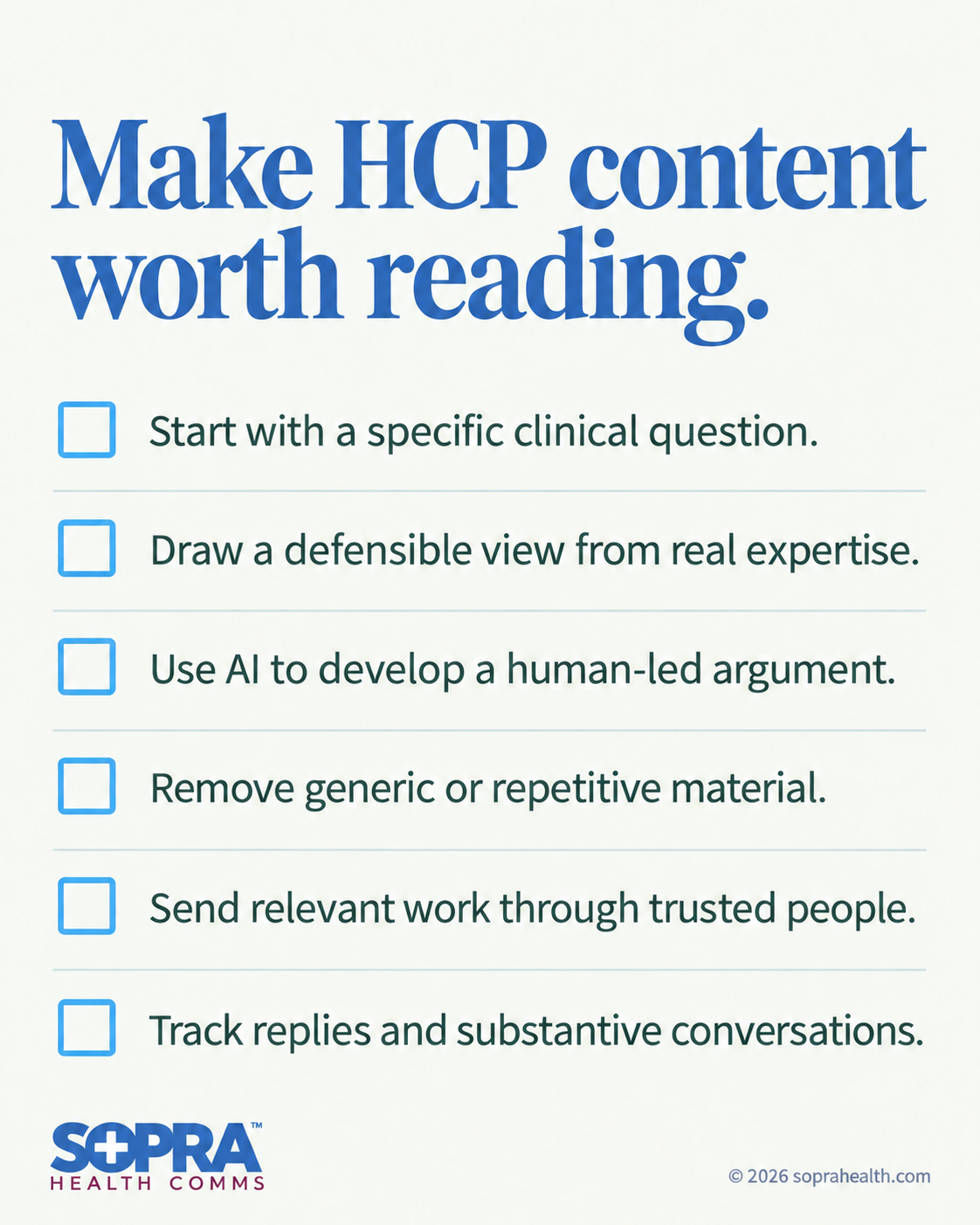
After adopting AI, an organization may need to reduce publication volume—sometimes by more than half—and invest the recovered time in two things the technology cannot independently provide: a consequential point of view and genuinely human distribution. This may sound inconveniently unlike the investment case for automation. That is precisely why the decision is unlikely to emerge from the content team alone.
The first requirement is a judgment worth publishing.
Every substantive piece should make a claim about the reader’s world: one that a competitor might hesitate to make and that a senior person would defend in conversation. Such judgments come from people who have encountered the problem closely. They may begin with a clinical lead’s unresolved disagreement with the literature, a pattern that emerged across ten physician conversations, or an objection raised by a medical advisory board that has never been adequately answered in public.
Generative AI can be extremely useful once that judgment exists. It can help organize evidence, explore structure, produce drafts, and adapt carefully considered material for different contexts. Used this way, it is an accelerant. What it cannot supply on its own is the underlying conviction, earned through experience and accountable to informed scrutiny. Without that, even an immaculate draft remains filler.
The second requirement is human distribution.
A thoughtful piece sent by a real person to the physicians whose daily experience it addresses may reach only a few dozen readers. The sender might be a medical science liaison, a founder, or a clinical adviser who adds two sentences explaining why the material is relevant. On an impressions dashboard, this can look modest to the point of embarrassment. In practice, it can begin the conversations that broad distribution rarely does.
The arithmetic deserves more honesty than it generally receives. Forty appropriate readers who reply, question, disagree, or continue the conversation may be more valuable than a large anonymous audience that passes silently through a reporting interface.
Measurement should reflect that difference. Content-volume metrics can be retired from the center of the review. In their place, teams can track replies, conversations initiated, and what priority physicians actually say about the material. These signals are smaller and less theatrical than impression counts, but they may tell an organization considerably more about whether its communications are influencing the human decisions relevant to prescribing.
The dashboard may look worse before the pipeline looks better. Leadership should say so in advance. A team that has successfully constructed a velocity machine deserves a candid explanation when the machine is assigned a different purpose.
Sopra Health senior consultants have reported that organizations moving from volume-based KPIs toward conversation-based measures have seen a 40% increase in qualified physician engagement within six months. That finding warrants formal substantiation and a clear definition of “qualified physician engagement,” but the direction of the observation is consistent with the larger argument: attention deepens when communication becomes more specific, accountable, and human.
None of this makes a case against AI. It makes a case for deciding what AI is for. Speed becomes leverage only when it is attached to something a person would choose to read.
What the Decline Revealed
The disappointing quarter may, on reflection, have produced the program’s most useful information of the year.
The falling numbers were a reply from the audience: quiet, aggregate, and unusually candid. They showed what busy people would no longer make room for. An organization willing to hear that reply can stop asking how many more pieces it might manufacture and begin asking a better question: What do we understand that could help this particular reader see a clinical reality more clearly?
Leaders from Sopra Health Comms have found that effective HCP content often succeeds at the point where clinical complexity becomes intelligible in relation to patient outcomes. The work is demanding because neither side of that bridge can be treated casually. Complexity must not be flattened, and patients must not be reduced to an emotional device appended to the final paragraph.
The physician with twenty unclaimed minutes is still there. Her inbox has not become shorter, and Tuesday has not become less complicated. But when she pauses over a piece of writing, it will not be because the machine produced it quickly. It will be because, somewhere in its sentences, she recognizes that another person has noticed the world she actually inhabits.
The Human Moment is Sopra Health’s essay series on the human side of healthcare growth — the patients, clinicians, and operators behind every human moment where healthcare and wellness decisions are made.
If you’re in need of help, tell us what challenge you’re facing. And if you’d like the next essay when it publishes, get the series by email. You can unsubscribe at any time.
Frequent questions about working together with Sopra Health Comms:
1. Why does AI content volume output often lead to lower engagement?
Increasing content output often reduces engagement because it prioritizes volume over relevance, effectively training your audience to ignore your brand’s signals. The decision to invest in content velocity rests on the common but flawed assumption that the constraint on engagement is supply, when it is actually a matter of trust.
2. How can healthcare brands recover from AI-content fatigue?
Brands can recover by abandoning volume-based metrics in favor of cultivating a distinct, defensible point of view that addresses specific clinical realities. This requires moving capacity away from high-volume production and into the two things AI cannot supply: unique clinical insights and human distribution.
3. What metrics should replace content-volume in performance reviews?
Instead of tracking impressions or content volume, organizations should track replies, conversations started, and what target physicians actually say about the material. The focus should shift to human responses, which, while small in number, are the ones that predict prescribing.
4. What role should AI play in a content strategy focused on engagement?
AI is a superb accelerant for drafting content around a real point of view. However, it cannot originate the judgment required to build trust, and a piece without a defensible point of view is filler regardless of how efficiently it was produced.