
CATEGORY HERE
One Team, Two Audiences That Want Different Things

Why the Standard Marketing Calendar Fails in Healthcare
A marketing calendar is an exceptionally tidy object. Its columns line up. Its campaigns have names. Its webinars, white papers, emails, and conference dates proceed across the quarters with the confidence of trains on a timetable.
The trouble begins when the passengers are headed to different cities.
In many early-stage healthcare companies, a small marketing team is expected to serve physicians and payers through one calendar, one campaign rhythm, and one broadly consistent body of messaging. On an organizational chart, this arrangement looks efficient. During an ordinary working week, it looks rather different.
The healthcare professional webinar is revised at the last minute so that it will “also work for payers.” The payer one-pager is softened so that it will not appear to contradict the physician materials. A clinical claim acquires an economic qualifier; an economic argument is given a patient-centered opening. Each alteration is defensible. Taken together, they produce work that is sensible, polished, and strangely inert.
The team has reached the middle.
This is frequently diagnosed as a content problem. The headlines need more energy. The formats need refreshing. The calendar needs filling. When performance remains disappointing, the usual remedy is to ask the same four people to produce more assets at greater speed—a response that has the reassuring familiarity of turning up the thermostat when someone has left a window open.
Yet the weakness began well before anyone wrote the copy. Physicians and payers are not simply two segments requiring different versions of the same message. They occupy different decision environments, answer to different constituencies, and assume different forms of risk. A single, averaged message may offend neither audience. That is not the same as persuading either one.
For Sopra Health, content is part of the passage between innovation and adoption. If that bridge is to bear weight, it must arrive where its intended audience is actually standing.
Two Rooms, Two Standards of Proof
Consider the physician encountering a new therapy, diagnostic, device, or model of care. The questions tend to be immediate and close to the practice of medicine:
Does the evidence hold up in patients like mine? What will this change in my workflow? Who will help when a patient calls with questions? If I champion this, will the decision prove sound?
These are clinical questions, but they are also professional and human ones. A physician reads the evidence through the realities of a specialty, a patient population, a care team, and a day already divided into units too small for the work expected of them. The theoretical elegance of an innovation matters. So do the prior authorization form, the training requirement, the follow-up call, and the seven minutes no one has accounted for.
Clinical audiences commonly look to specialty publications, professional societies, colleagues, and other trusted sources. Content intended for them therefore earns attention through specificity. It respects the evidence, acknowledges uncertainty, and describes the burden of care honestly. It does not behave as though implementation occurs in a bright, empty room with unlimited staff.
Across the table sits the payer audience: perhaps a medical director, pharmacy leader, or utilization-management executive. The subject may be the same, but the unit of judgment has changed. The questions now concern populations, utilization, and financial exposure:
What is the effect on total cost of care across ten thousand covered lives? What assumptions drive the budget-impact model? Will those assumptions survive actuarial review? If coverage expands utilization, what happens next? How will this decision be defended before a committee?
A payer may care deeply about patient outcomes. The role, however, requires those outcomes to be considered across a covered population and within a system of finite resources. Evidence must travel through models, forecasts, benefit structures, review processes, and institutional scrutiny. Enthusiasm is therefore less useful than an argument that can withstand several rounds of skeptical questions from people paid to notice what has been omitted.
This is where a familiar healthcare asymmetry appears. One party may possess more, better, or simply different information than another. Clinical teams, patients, manufacturers, and payers do not see the same evidence from the same vantage point. Their incentives may not align neatly, and the resulting information asymmetry can distort decisions and waste resources. Communication cannot eliminate that condition, but careless communication can certainly make it worse.
Sopra Health’s senior consultants have found that forcing economic arguments into clinical content tends to weaken credibility with both audiences. The physician encounters population-level abstractions where practical clinical guidance should be. The payer encounters uplift and narrative where assumptions, utilization scenarios, and financial consequences should be.
The problem is not that one audience values patients while the other values money. That caricature is convenient and largely useless. The distinction lies in the decision each audience must make, the evidence it must defend, and the consequences it is responsible for managing.
Physicians need clinical depth, applicability, and candor about implementation. Payers need population-level reasoning and economic evidence sturdy enough for actuarial and committee review. A message built primarily for one will often leave the other with unanswered questions. Combining the two rarely produces a satisfying compromise. More often, it produces material that fails two different tests with admirable consistency.
The Decision Hidden in the Org Chart
A four-person team facing this assignment has not merely been given a difficult job. It has inherited a contradiction.
No executive meeting may have concluded, explicitly, that physicians and payers should be treated as one audience. The decision was made more quietly. There was one marketing team, and therefore one marketing motion. The calendar followed the headcount. In time, that administrative convenience acquired the dignity of strategy.
The team then absorbed the consequences. Every asset became a negotiation between competing agendas. Every performance report suggested that execution was at fault. More content was commissioned; more revisions were requested; more pressure accumulated. The original design decision remained safely out of sight.
This helps explain why the remedy cannot be found solely inside the calendar. The calendar records priorities. It does not choose them.
Redrawing the Motion
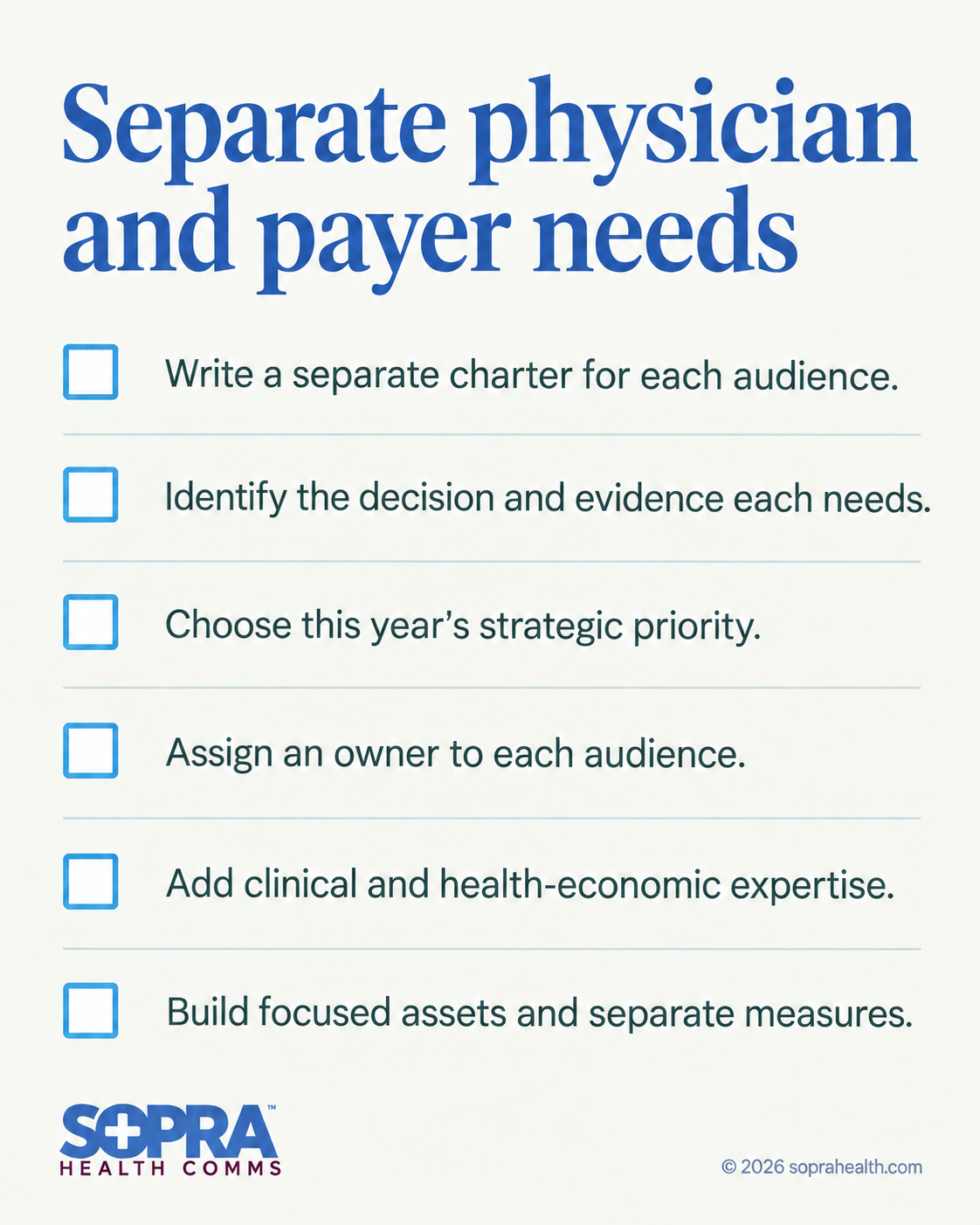
The practical correction requires three decisions. None necessarily requires additional headcount.
1. Give each audience its own charter
Create two one-page audience charters: one for physicians and one for payers. Each should identify the specific person being addressed, the decisions that person must make, the questions likely to govern those decisions, the evidence and formats they trust, and the channels through which they seek information.
Then make the choice companies often postpone: Which audience is strategically primary this year?
For some organizations, payer coverage will take precedence because it enables downstream adoption. For others, clinical acceptance or appropriate utilization may need to come first. The answer depends on the product, evidence base, market, regulatory position, and commercial strategy. The value lies in choosing deliberately.
A single page of disciplined priority-setting can reallocate more effort than an elaborate hiring plan because it gives the team permission to stop treating every audience as equally urgent at every moment.
2. Give each motion an owner
One person should own the physician motion and another the payer motion, even when each can devote only part of the week to it.
This is less about dividing tasks than about establishing informed advocacy. Each audience needs someone inside the company who understands its standards well enough to recognize when an asset will fail. Someone should be able to say, before publication, that a claim lacks the clinical qualification a physician will expect—or that an economic argument will not survive a payer committee.
Shared ownership often sounds collaborative. In practice, it can leave important judgments ownerless.
3. Acquire the capability the team does not possess
Payer communications may require health-economic evidence, budget-impact modeling, population-level analysis, and materials designed for formal review. These are specialist capabilities. They should be treated with the same seriousness as other technical disciplines in healthcare.
The company may contract for that expertise, retain it fractionally, or eventually hire it. That is an ordinary build-versus-buy decision. Assigning the work to whichever generalist has space on Thursday afternoon is also a decision, though rarely one that improves under scrutiny.
The same principle applies on the clinical side. Subject-matter depth, medical review, and implementation insight cannot be conjured through tone or formatting. The capability behind the content matters because sophisticated audiences can usually tell when it is absent.
Fewer Things, Better Aimed
Once the two motions are separated, the calendar may become thinner. This can feel unsettling, particularly in organizations where output is counted more easily than relevance.
There may be fewer assets. Each, however, will know whom it is addressing. A physician resource can answer a clinical question without carrying the additional burden of a budget-impact argument. A payer document can examine assumptions, utilization, and economic consequences without being required to double as an inspirational account of innovation.
For a time, the reduction in volume may resemble a reduction in productivity. Eventually, the data should distinguish between them. Four people working with precision can outperform four people assigned to occupy the middle, because precision allows every hour—and every asset—to have a defined purpose.
Every marketing structure contains a theory of its audience, whether leadership has articulated that theory or merely inherited it. One calendar for physicians and payers quietly proposes that the two can be moved by the same evidence, in the same language, at the same moment.
They cannot always be. They are making different decisions in different rooms, under different kinds of scrutiny.
The team described as underperforming may simply have been carrying the cost of an old organizational convenience: a bet placed so quietly that no one remembered placing it. Once that bet is visible, the calendar becomes less tidy. The work becomes more honest. And the people receiving it may finally recognize that someone has understood the decision they are actually being asked to make.
The Human Moment is Sopra Health’s essay series on the human side of healthcare growth — the patients, clinicians, and operators behind every human moment where healthcare and wellness decisions are made.
If you’re in need of help, tell us what challenge you’re facing. And if you’d like the next essay when it publishes, get the series by email. You can unsubscribe at any time.
Frequent questions about working together with Sopra Health Comms:
1. Why does the standard marketing calendar fail in healthcare marketing?
The standard marketing calendar fails in healthcare because it attempts to serve two distinct, competing audiences—physicians and payers—with a single, averaged message. This results in content that is too clinical for payers and too financial/economic for physicians, ultimately failing to persuade either group.
2. How do physician and payer marketing strategies differ in healthcare?
Physician and payer marketing strategies differ fundamentally in their decision environments and standards of proof:
– Physicians prioritize individual clinical outcomes, practical workflow impacts, and evidence-forward details. They trust peer-reviewed evidence and specialty journals.
– Payers focus on population-level health economics, total cost of care, budget-impact models, and actuarial safety. They require rigorous economic arguments that can withstand committee scrutiny.
3. How can organizations optimize their healthcare marketing content calendar to resolve audience conflict?
Organizations can optimize their content calendar and resolve audience conflicts through three key organizational actions:
Separate the motions on paper: Create distinct, one-page audience charters for physicians and payers, and clearly designate which audience is the strategic priority for the year.
Assign fractionated ownership: Appoint specific owners for each audience motion to advocate for their respective standards of proof before assets ship.
Acquire specialized capabilities: Rent, contract, or hire specialist expertise for complex payer marketing (such as health-economic modeling) instead of relying on generalists.
4. What is information asymmetry in healthcare communication?
Information asymmetry is a market condition where one party possesses superior or more detailed information than another. In healthcare, this asymmetry often leads to misaligned incentives and inefficient resource allocation among clinical teams, patients, manufacturers, and payers, which can be exacerbated by generalized, averaged communication.
5. How does separating content streams improve healthcare marketing performance?
Separating content streams may reduce total content volume, but it allows for extreme precision. Each asset can focus purely on answering either a clinical or economic question without compromise, resulting in higher relevance, stronger audience credibility, and better overall campaign performance.