CATEGORY HERE
The Technology Beneath the Handshake: Engineering Field Logistics for Healthcare

Grassroots healthcare outreach appears deceptively simple from a distance. A trusted local organization distributes information. A field representative visits a clinic. A patient learns where to find help. The materials arrive in the right language, bearing the right disclosures, before the event rather than three days afterward.
Each act is modest. Coordinating thousands of them across distinct healthcare markets is not.
This is the operational difficulty concealed inside person-to-person engagement. Distributed field teams must work alongside local clinical and advocacy relationships, using materials adapted to regional circumstances and cleared for the regulations that govern them. Inventory must be produced, delivered, replaced, and accounted for. Interactions in the field must become usable information without reducing human conversations to a row of indifferent numbers.
Many traditional marketing agencies retreat from this work not because local outreach lacks value, but because its administrative demands are considerable. Their systems were built to place media, publish content, and measure digital response. Ask those same systems to coordinate physical deployment across dozens of markets, and the machinery begins to protest. Administrative costs rise. Local variations are missed. Data arrives late, partially, or not at all.
The difficulty is not the handshake. It is everything required to make the handshake possible—and to understand what happened afterward.
Sopra Health calls its approach to this problem “Human-Tether Method”: the practice of identifying, staffing, and monitoring the places in a clinical or community workflow where automated activity loses momentum and human trust becomes consequential. These connections are often easy to overlook because they do not announce themselves as failures. They appear as an unanswered question, a referral that goes unfinished, a useful resource that cannot be found, or a patient who leaves intending to follow up.
Technology has a particular role here. It should not insert itself between an organization and the people it hopes to reach. It should remain largely beneath the encounter, carrying the operational weight.
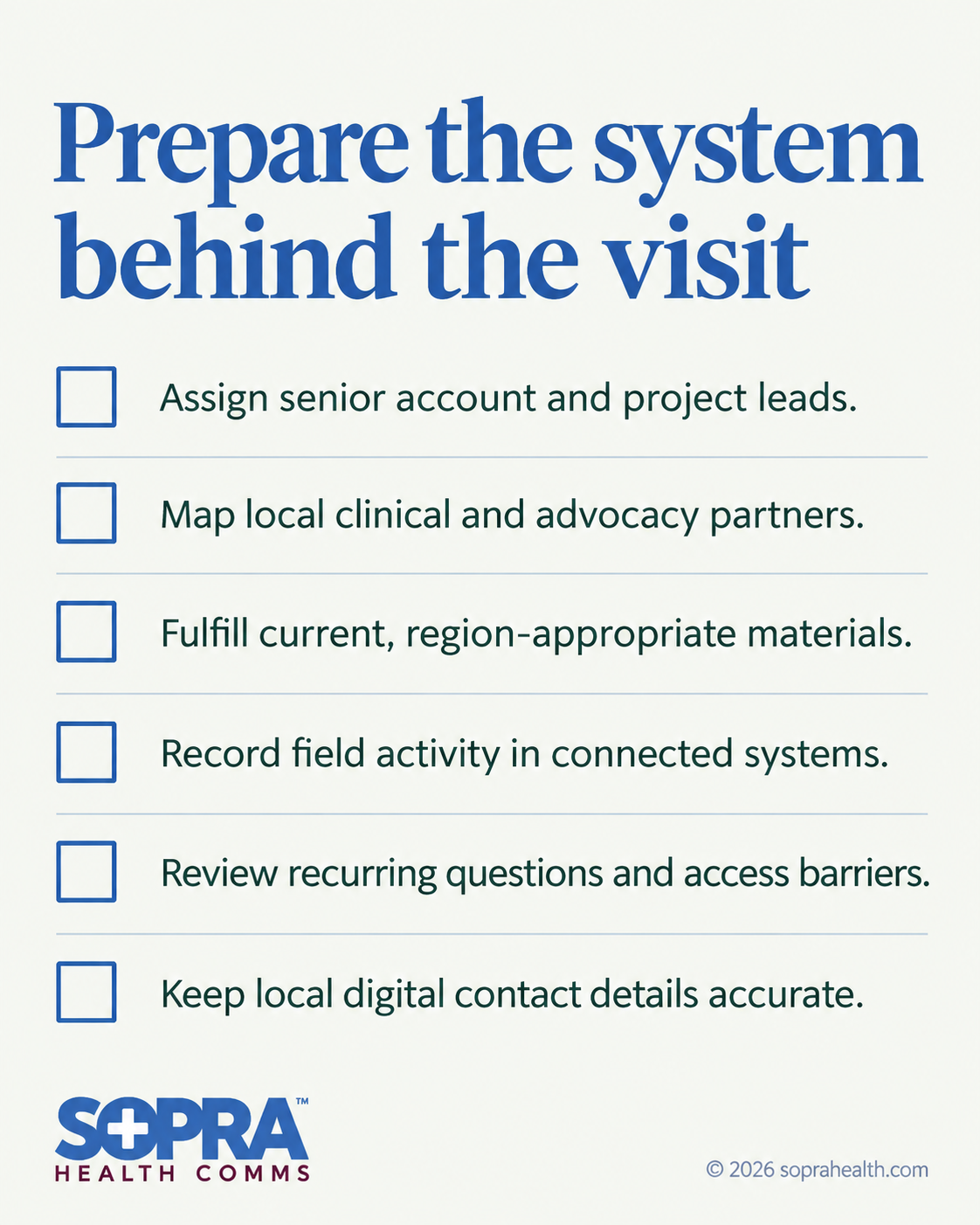
The Sopra Health model places a senior account lead and senior project manager at the center of the work. Around them sits an integrated technical infrastructure comprising AI-assisted hyperlocal sourcing, centralized logistics, and closed-loop attribution.
Geographic data helps identify relevant local nodes, clinical networks, and advocacy organizations. Centralized fulfillment supports the distribution of pre-cleared, state-appropriate assets and customized tools. Field activity is documented at its source and routed into customer relationship management systems, allowing outreach teams and growth leaders to examine what is happening across markets rather than relying on recollection, anecdote, or the occasional heroic spreadsheet.
AI-assisted synthesis can also help organize large volumes of unstructured field notes into usable market intelligence. Patterns that would be difficult to discern one report at a time—recurring questions, local barriers, incomplete referral paths, or gaps in available materials—can be identified for human review. The judgment remains human; the sorting need not be.
The same discipline extends to digital findability. Physical outreach may create interest, but that interest often travels home in a pocket beside a folded leaflet. Later, someone searches for a clinic, a program, or an organization. If location profiles are inaccurate, contact details conflict, or the relevant resource is buried, the promise made in person quietly expires online. Maintaining digital hygiene across multi-location networks is therefore part of field logistics, even if no one at the community event would think to call it that.
Integration cannot make every human interaction measurable, nor should it try. Trust is not a unit of inventory, and attribution in healthcare rarely proceeds in a perfectly straight line. A well-designed operational system can nevertheless provide clearer visibility into where resources were placed, which outreach occurred, what questions emerged, and how interest moved through the subsequent pathway.
That is the purpose of the technology beneath the work. It gives senior operators more time to exercise judgment, local partners more dependable support, and healthcare leaders a more credible view of where effort and capital are going. The system does not replace the human presence at the center of community engagement. Properly built, it is what allows that presence to arrive prepared.
The Human Moment is Sopra Health’s essay series on the human side of healthcare growth — the patients, clinicians, and operators behind every human moment where healthcare and wellness decisions are made.
If you’re in need of help, tell us what challenge you’re facing. And if you’d like the next essay when it publishes, get the series by email. You can unsubscribe at any time.
Frequent questions about working together with Sopra Health Comms:
1. What is Human-Tether Method?
Human-Tether Method is the operational practice of identifying, staffing, and monitoring the specific points in a clinical or community workflow where automated digital motions waver and human connection and trust becomes necessary. Rather than replacing human interaction, technology is deployed beneath the surface to carry the operational, regulatory, and logistical weight, ensuring field teams can build high-touch relationships smoothly and effectively.
2. How does Sopra Health leverage technology in field logistics?
Sopra Health uses integrated technical infrastructure combining AI-assisted hyperlocal sourcing, centralized logistics, and closed-loop attribution. Geographic mapping identifies key clinical and advocacy nodes, centralized fulfillment delivers pre-cleared state-compliant tools, and AI synthesis organizes large volumes of unstructured ground-level field notes into actionable market intelligence.
3. What are the benefits of the Sopra Health operational model?
By placing senior account leads and project managers at the core of operations and automating administrative and logistical hurdles, Sopra Health eliminates fixed-roster overhead, reduces localized compliance errors, prevents data blindness, and allows operators to focus fully on high-fidelity human connections and strategic judgment.
4. How does Sopra Health ensure data attribution and compliance?
Every local placement, outreach metric, and field interaction is documented at its source and instrumented through closed-loop tracking systems routed directly into customer relationship management (CRM) platforms. Combined with centralized fulfillment of state-cleared assets, growth leaders gain clear capital visibility, reliable data attribution, and predictable growth metrics while remaining fully compliant.