
HYPER LOCAL MARKETING
Hyper-Local Is a System, Not a Sponsorship

What the Audit Reveals
After a franchise system acquires a group of clinics, the first surprises are often modest ones.
A Google Business profile remains unclaimed. Tuesday’s hours are wrong. A telephone number belongs to another era, if not another office. Individually, these seem like housekeeping matters—the administrative lint that accumulates while everyone is occupied with patients, staffing, reimbursement, and the other small urgencies from which healthcare is assembled.
Then the performance data introduces a second surprise. The clinics doing especially well are not necessarily those with the newest interiors or the most favorable demographics. They are often the ones whose owners and clinicians have become familiar figures beyond the clinic door: staffing a high school football game, teaching a mobility class at the YMCA, or supporting a local racing club.
The two findings may appear to belong in different sections of the audit. One concerns digital maintenance; the other, community relationships. In practice, they describe the same neglected system.
A clinic grows by becoming both known and findable. Yet many organizations leave the first condition to personal inclination and the second to whoever happens to remember the password. A naturally sociable owner joins committees, attends events, and learns half the town by name. A quieter clinician—possibly every bit as capable—may prefer the order of the treatment room to the amiable disorder of a community gathering. The organization then mistakes temperament for strategy.
Community presence should not depend upon whether a clinic owner happens to be a joiner. It is an operational asset, and it can be supported accordingly.
How Local Trust Travels
Healthcare choices are made under unusual conditions. A patient deciding where to seek physical therapy or primary care cannot readily assess clinical quality in advance. The provider knows considerably more about the care than the patient does—a familiar form of information asymmetry, though the phrase is tidier than the experience.
Patients therefore look for signals. Is this clinic respected? Does it understand people like me? Has someone I trust encountered these clinicians somewhere other than an advertisement?
The answers tend to travel through ordinary life. A therapist is seen at the gym. A neighbor mentions a name. A community organization invites a clinic to offer a useful program. Familiarity gathers gradually, through repeated encounters that may appear inconsequential until someone needs care.
This is borrowed trust: credibility acquired through a genuine association with an organization, event, or institution that a community already knows. It cannot simply be claimed in a campaign. It arrives by way of participation.
Local search performs a different but complementary function. Community presence creates recognition and confidence; accurate digital information allows people to act on them. A clinic that appears prominently online but nowhere in community life must compete largely on distance, availability, and star ratings. An established local presence with inaccurate listings presents the opposite difficulty: demand has been earned, only to be misdirected by an old telephone number or an incorrect closing time.
Digital-only marketing attempts to purchase, one impression at a time, a degree of trust that meaningful local participation can generate more naturally. Community involvement without sound digital maintenance, meanwhile, resembles holding the door open while leaving the lights off. Neither failure is dramatic. Both are expensive.
Making Presence Repeatable
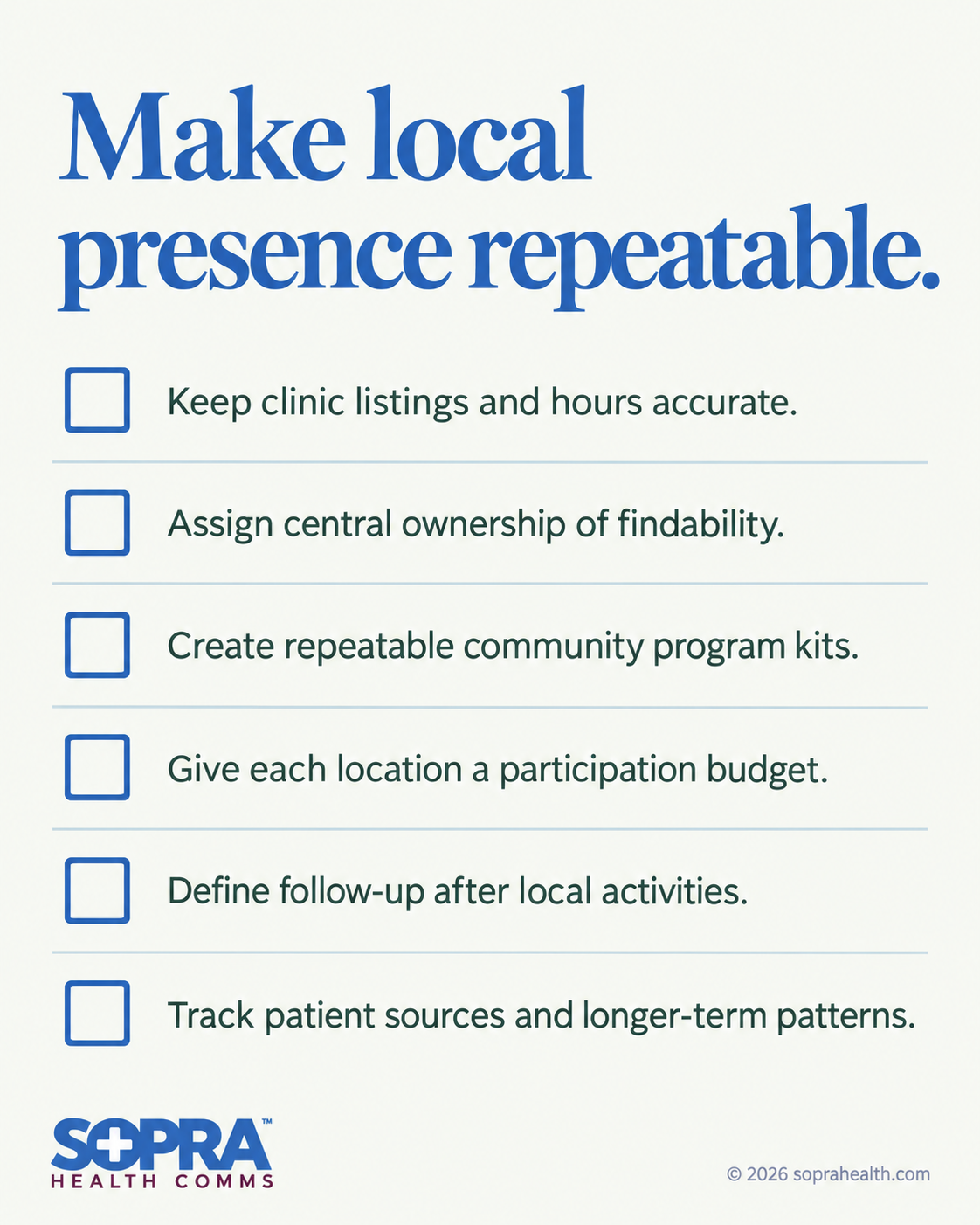
The practical question is how to preserve the human character of local engagement while making it reliable across a system. The answer begins with three coordinated layers.
First, headquarters should manage findability centrally. Listings, profiles, hours, contact information, and review practices are system responsibilities. Removing this work from individual franchisees improves consistency and allows locally generated interest to reach the right clinic. It also spares clinicians from becoming reluctant custodians of platforms whose rules and interfaces change with suspicious enthusiasm.
Second, effective community programs should be made repeatable. A free gait check, a mobility class, or another useful local offering can be documented as a presence kit containing the necessary checklist, script, signage, and follow-up process. Standardization need not make an encounter impersonal. At its best, it clears away logistical friction so that clinicians can concentrate on the people in front of them.
Third, local participation requires an explicit budget and sensible measurement. A modest allocation at the clinic level signals that community engagement is part of the operating model rather than a charitable extra funded from an owner’s pocket. New-patient source data can then help distinguish productive programs from pleasant activities that produce little beyond a photograph and a folding table.
Leaders from Sopra Health Comms have reported that clinics moving from sporadic community involvement to structured local engagement programs experience a 20–30 percent increase in patient-acquisition consistency within the first six months. That observation should be evaluated against a clearly defined methodology: what constitutes consistency, which clinics were included, how acquisition was attributed, and what other operational changes occurred during the period.
Measurement matters, although hyper-local growth does not always conform neatly to the calendar. Trust compounds. A class taught this month may lead to a recommendation several months later, passed between two people whose conversation will never appear in a marketing dashboard. The aim is neither to abandon accountability nor to pretend that every relationship can be reduced to a direct-response transaction.
The Work Beneath the Sponsorship
A sponsorship can place a clinic’s name on a banner. A local operating system determines what happens before and after the banner comes down.
It keeps the clinic’s information accurate. It gives clinicians practical ways to contribute their expertise. It provides enough funding to make participation feasible and enough measurement to make it accountable. Most importantly, it allows community presence to survive differences in personality, leadership transitions, and the thousand competing demands of clinical work.
The result is greater consistency in growth, but also something less easily purchased: a clinic that occupies a recognizable place in the life around it. When care is needed, people do not encounter a name for the first time. They remember where they have seen it—and, more consequentially, what it was doing there.
The Human Moment is Sopra Health’s essay series on the human side of healthcare growth — the patients, clinicians, and operators behind every human moment where healthcare and wellness decisions are made.
If you’re in need of help, tell us what challenge you’re facing. And if you’d like the next essay when it publishes, get the series by email. You can unsubscribe at any time.
Frequent questions about working together with Sopra Health Comms:
1. How can healthcare clinics improve patient acquisition?
Healthcare clinics can improve patient acquisition by balancing robust digital hygiene (such as maintaining accurate Google Business profiles) with active, structured community integration (like offering local mobility classes or gait checks). This dual approach builds trust offline and successfully captures demand online.
2. What is the difference between a local sponsorship and a hyper-local system in healthcare?
A local sponsorship simply places a clinic’s name on a banner. In contrast, a hyper-local system operationalizes community presence as infrastructure by centrally managing digital findability, providing standardized presence kits for local events, and dedicating a specific local budget to build reliable, long-term trust.
3. How do clinics build trust in their local communities?
Clinics build trust through direct participation in community life. This participation leverages ‘borrowed trust’ from respected local organizations and events, signaling quality and helping patients overcome information asymmetry when choosing a healthcare provider.
4. Why is digital hygiene critical for local medical practices?
Digital hygiene is critical because it captures the patient demand generated by community involvement. A clinic with an active community presence but inaccurate listings or outdated profiles will leak interested patients to competitors who are easier to find online.
5. How can a healthcare franchise system scale community presence across multiple locations?
A healthcare franchise system can scale presence by taking the administrative burden of digital profiles off individual owners, packaging successful local events into repeatable ‘presence kits’ (with checklists and scripts), and establishing an explicit budget and measurement system.