
CATEGORY HERE
Turning Community Presence into Scalable Infrastructure

The Limits of the National Playbook
A national healthcare campaign has a certain appealing neatness. One strategy. One set of messages. One dashboard glowing reassuringly in a conference room. From a distance, the country begins to resemble a single market.
Healthcare, however, is usually encountered at close range.
It takes shape in a physician’s referral habits, a state’s regulatory requirements, a clinic’s scheduling practices, and the quiet customs by which one community shares information while another disregards it. An innovation that moves readily through a direct-access market may stall elsewhere because care is organized around primary care networks. The campaign remains the same; the conditions governing its success have changed.
Traditional agencies often rely on national digital programs because local execution demands a different kind of capability: relationships, field coordination, regulatory awareness, and the patience to understand how a place actually works. Without that infrastructure, geographic variation becomes a line in a strategy document rather than a force shaping the investment itself. Money is distributed evenly across markets that are anything but even.
The result is less a failure of creative ambition than of proximity. A message devised for everyone may arrive with admirable efficiency and very little local consequence.
What the Folding Table Knows
Community engagement is sometimes filed under goodwill—a worthy but faintly ungovernable category, alongside sponsorships, civic appearances, and other activities whose results are expected to be wholesome rather than measurable.
The work itself is more revealing.
A clinic offers screenings at a community event. A field team staffs a folding table. An organization supports a neighborhood sports league or distributes educational materials through a trusted local partner. People stop, hesitate, ask questions, choose one word instead of another, or disclose the practical concern that prevented them from seeking care. By the time these observations travel back through the organization, they have often softened into generalities: interest was strong; awareness remains limited; the community has questions.
This is passive feedback entropy—the gradual conversion of useful local knowledge into institutional fog.
The Sopra Health approach treats community engagement as an operating channel rather than an incidental expression of goodwill. The questions, anxieties, and language encountered at physical touchpoints can reveal unmet needs with unusual immediacy. Surveys and focus groups remain valuable, but they gather information within conditions designed by the researcher. Community presence offers another view: what people ask when the conversation begins on their own terms.
Capturing that view consistently requires more than an outgoing clinician, a box of brochures, and a fortunate Saturday afternoon. It requires a system.
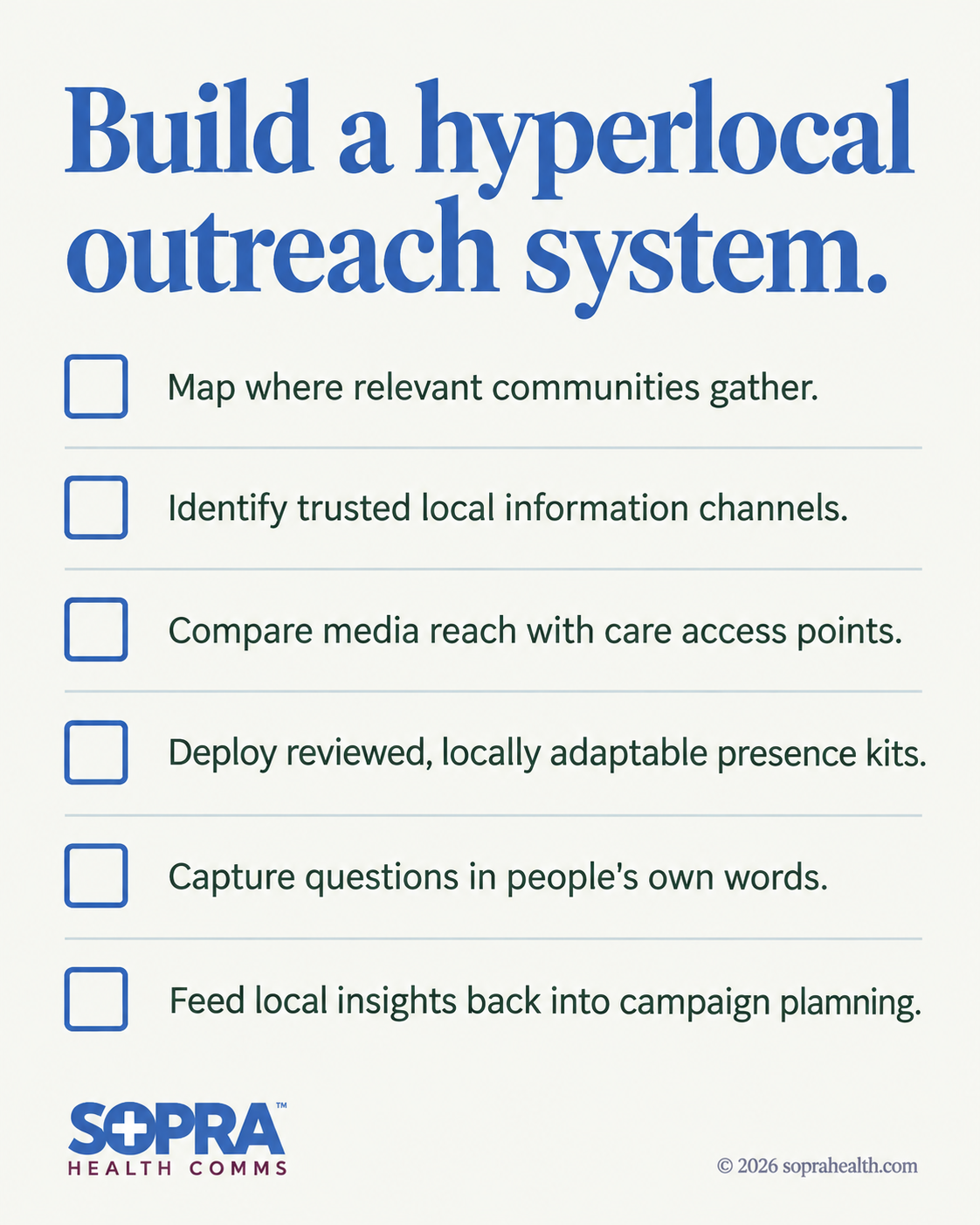
The Sopra Proximity Mapping Method
The Sopra Proximity Mapping Method organizes hyperlocal engagement through four connected disciplines.
- Isolate hyperlocal nodes.
The first task is to identify where the relevant population already gathers and where care-related decisions are likely to take shape. These nodes may include community-based organizations, regional specialist corridors, and neighborhood venues. The aim is to follow existing patterns of trust and movement rather than assume that attention can simply be summoned. - Audit localized information flows.
Every community has its own routes by which information acquires credibility. Hyperlocal publishers, regional clinical advocates, and ethnic media networks may command an attention that national reach cannot reproduce. Cataloguing these channels reveals who is heard, where messages travel, and which sources people consult before taking the next step. - Analyze proximity overlap.
Geospatial analysis can then examine where trusted media footprints intersect with the physical locations at which people initiate care. This overlap matters. A community outlet and a clinical access point may each be valuable independently; their geographic relationship can make the combined opportunity more consequential. - Deploy repeatable presence kits.
Once priority nodes have been identified, field teams need materials that are centralized, pre-cleared, and adaptable to local conditions. These “Presence Kits” translate complex clinical ideas into compliant, human-scale tools: a specialized mobility check, for example, or a structured educational packet that can support a real conversation rather than merely occupy a display stand.
Standardization gives the work continuity. Local adaptation gives it relevance. Repeated presence allows familiarity to accumulate, while disciplined capture of field observations returns local intelligence to the larger organization.
This is how an activity once dismissed as difficult to measure begins to function as infrastructure. The folding table remains a folding table. Yet around it, with the right system in place, a market can become visible in the particular language people use, the places they trust, and the ordinary decisions through which care actually begins.
The Human Moment is Sopra Health’s essay series on the human side of healthcare growth — the patients, clinicians, and operators behind every human moment where healthcare and wellness decisions are made.
If you’re in need of help, tell us what challenge you’re facing. And if you’d like the next essay when it publishes, get the series by email. You can unsubscribe at any time.
Frequent questions about working together with Sopra Health Comms:
1. What is Passive Feedback Entropy in healthcare outreach?
Passive feedback entropy is the rapid decay of raw, ground-level patient feedback and clinical insights gathered during physical community events into vague, unmeasurable organizational noise as it travels up to corporate executives.
2. What is the Sopra Proximity Mapping Method?
The Sopra Proximity Mapping Method is a data-driven, four-step framework used by Sopra Health to map and engage local healthcare markets. The steps include:
Isolate Hyperlocal Nodes: Mapping where target populations naturally gather, such as community-based organizations (CBOs), specialist corridors, and neighborhood venues.
Audit Localized Information Flows: Identifying the regional clinical advocates, ethnic media, and community publishers that command high-fidelity attention.
Analyze Proximity Overlap: Using geospatial analytics to pinpoint where trusted media footprints overlap with physical locations where patients initiate care.
Deploy Repeatable Presence Kits: Supplying field teams with centralized, pre-cleared, and locally adaptable tools to turn complex clinical concepts into standardized community resources.
3. Why do national, one-size-fits-all digital healthcare playbooks often fail?
National playbooks fail because healthcare delivery is a fundamentally localized phenomenon. Variations in regional clinical workflows, state-level regulatory constraints, and local referral patterns dictate success. A campaign designed for a direct-access market will fail in a territory gated by rigid primary care networks.
4. How does Sopra Health transform grassroots community engagement into scalable infrastructure?
Sopra Health treats physical touchpoints (such as local screenings, folding tables, and events) as structured, measurable operating channels rather than unmeasurable “goodwill” expenses. By equipping field teams with standardized, pre-cleared “Presence Kits” and systematically capturing raw patient questions and local vernacular, Sopra Health converts grassroots interactions into predictable growth and high-fidelity market intelligence.